Type two letters or more to filter to the passages that mention it. Press Enter to step through them, Shift+Enter to step back, Esc to clear.
J
First off, tell us a little bit about yourself before we even get into the war stuff.
A
Where do we want to start off? I mean, what do you mean by that?
J
Well, just a little bit about your background or how you were raised, born. You know, my name is... Okay, my name... Not yet. Stuff like that. What kind of family you were brought up on leading up...
A
You know, just maybe about five minutes leading up to what made you decide to join the National Guard.
J
So just take it as it comes to you.
A
All right.
J
Any time now.
A
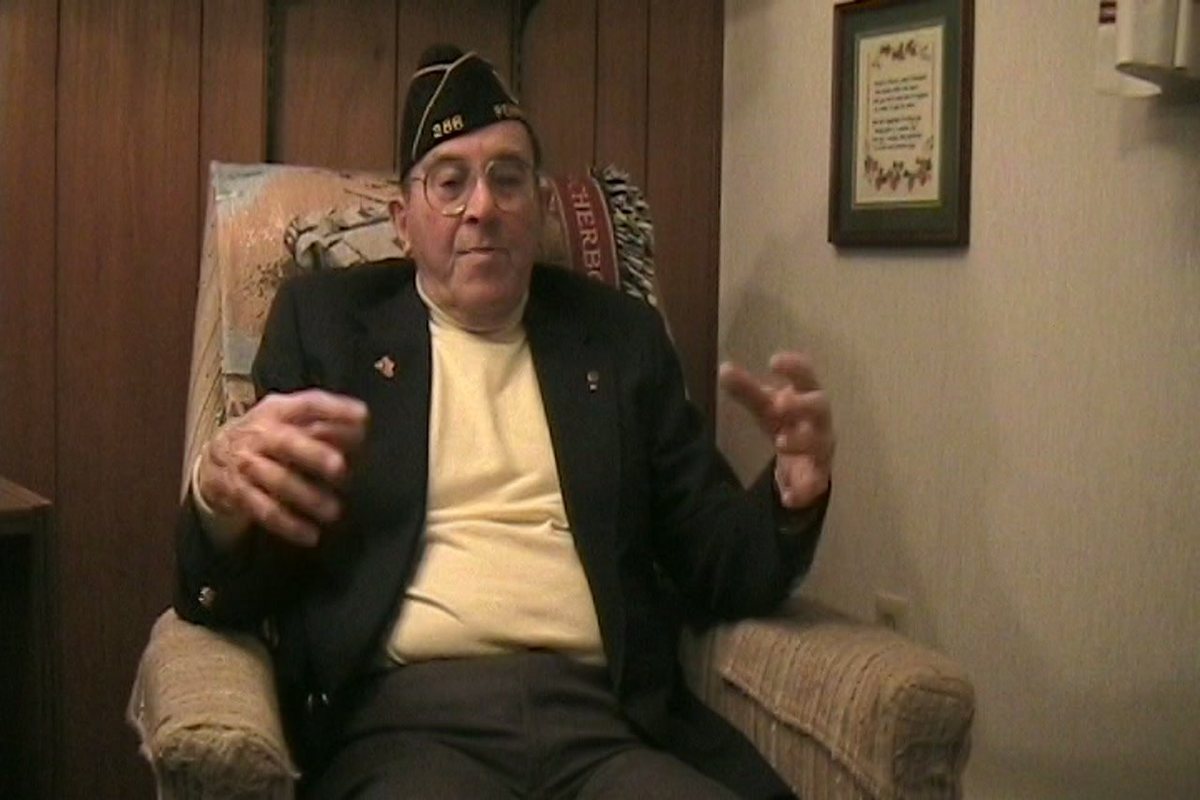
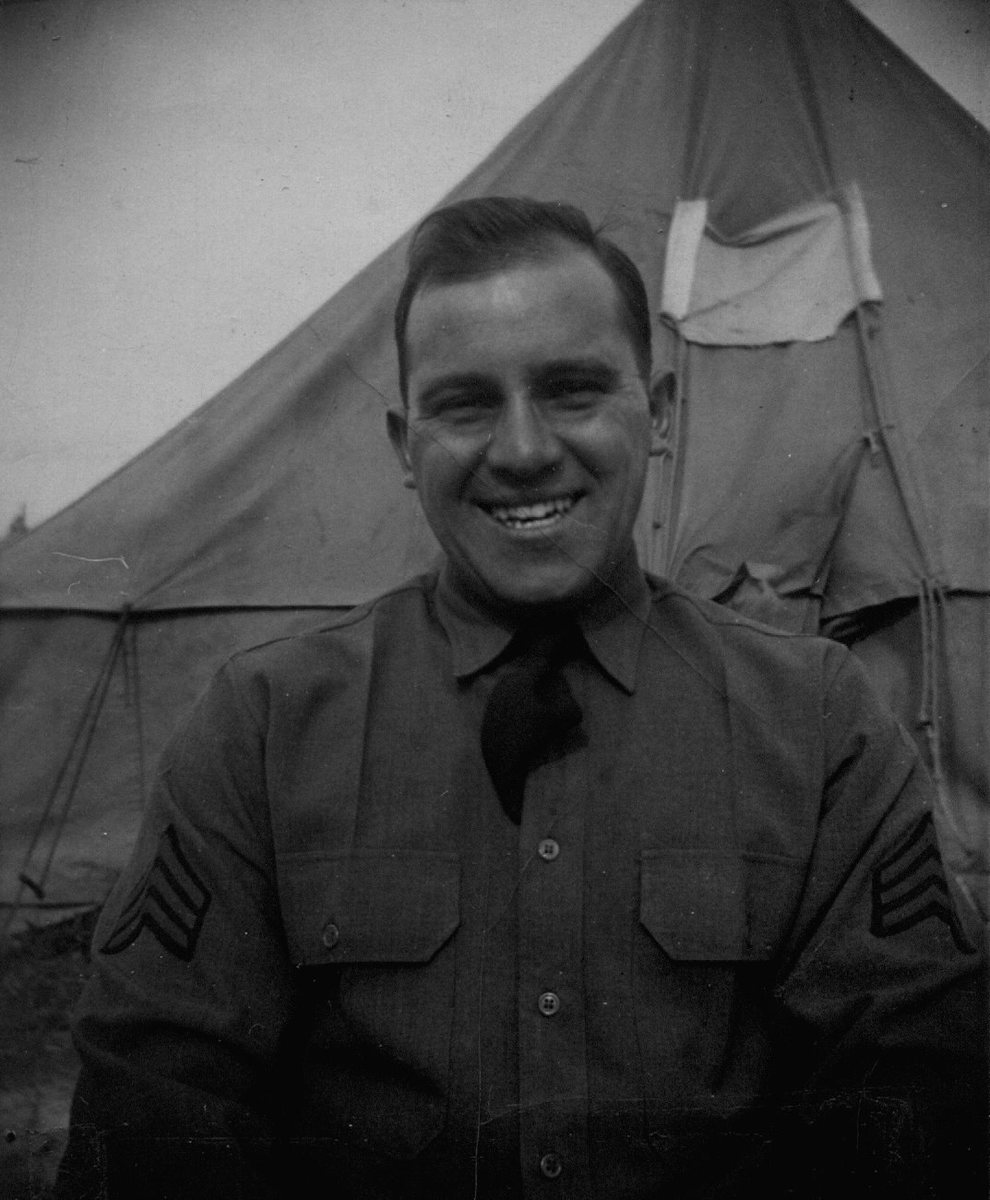
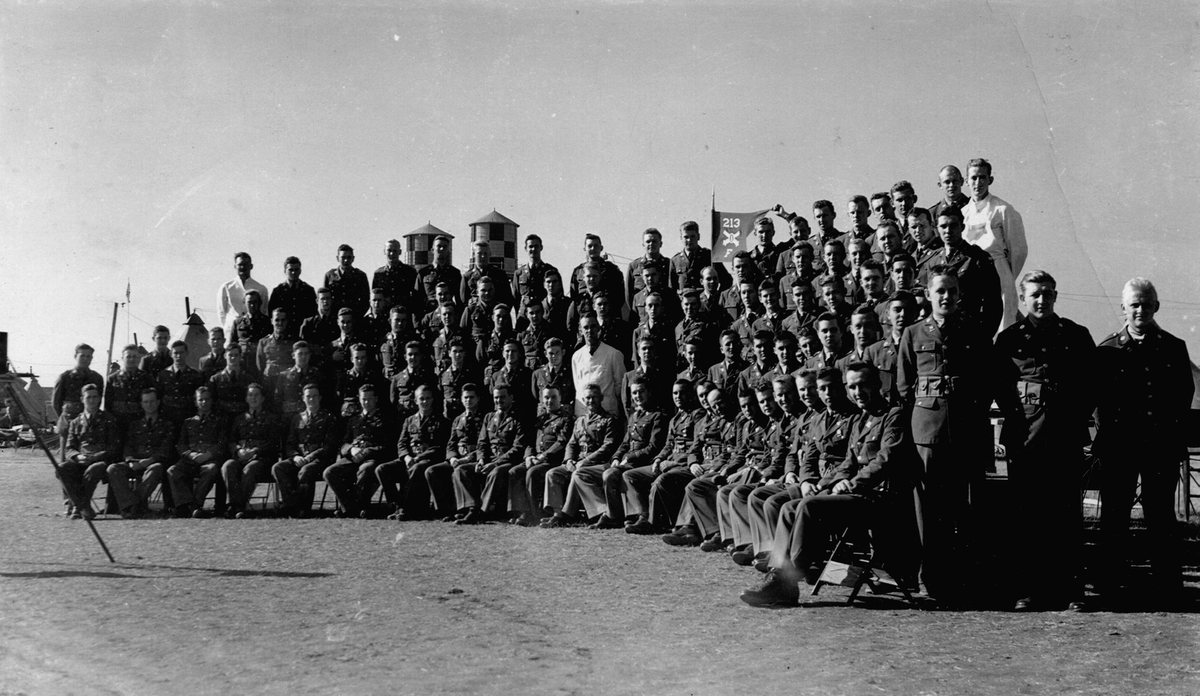
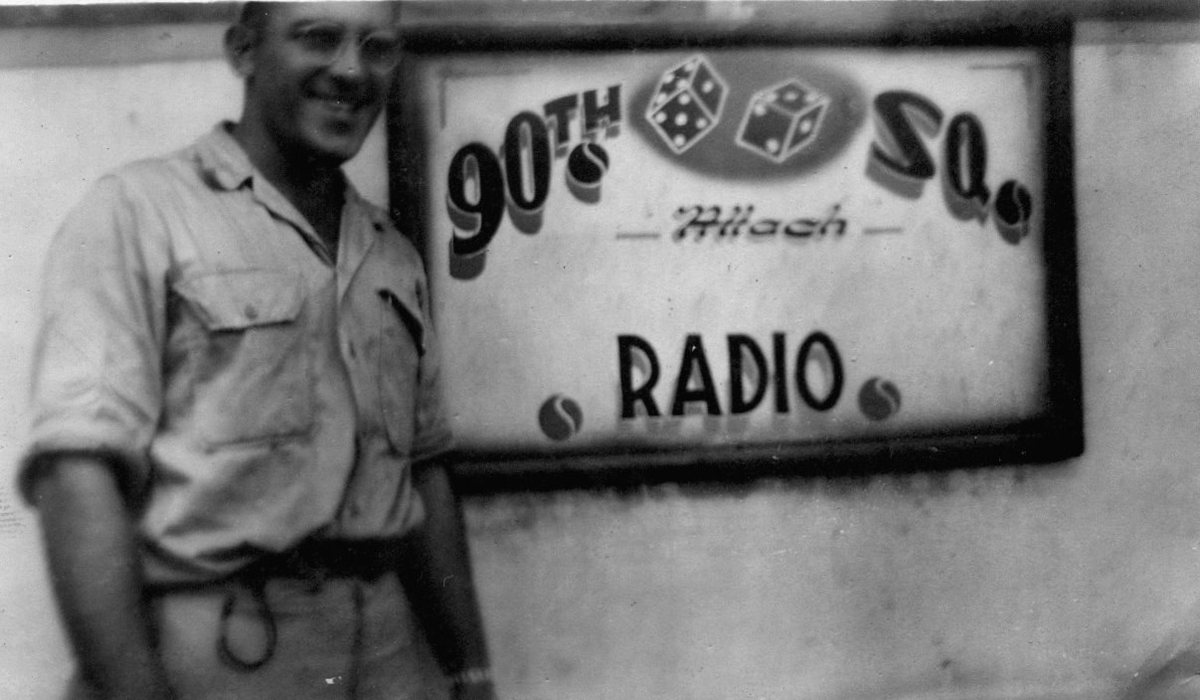
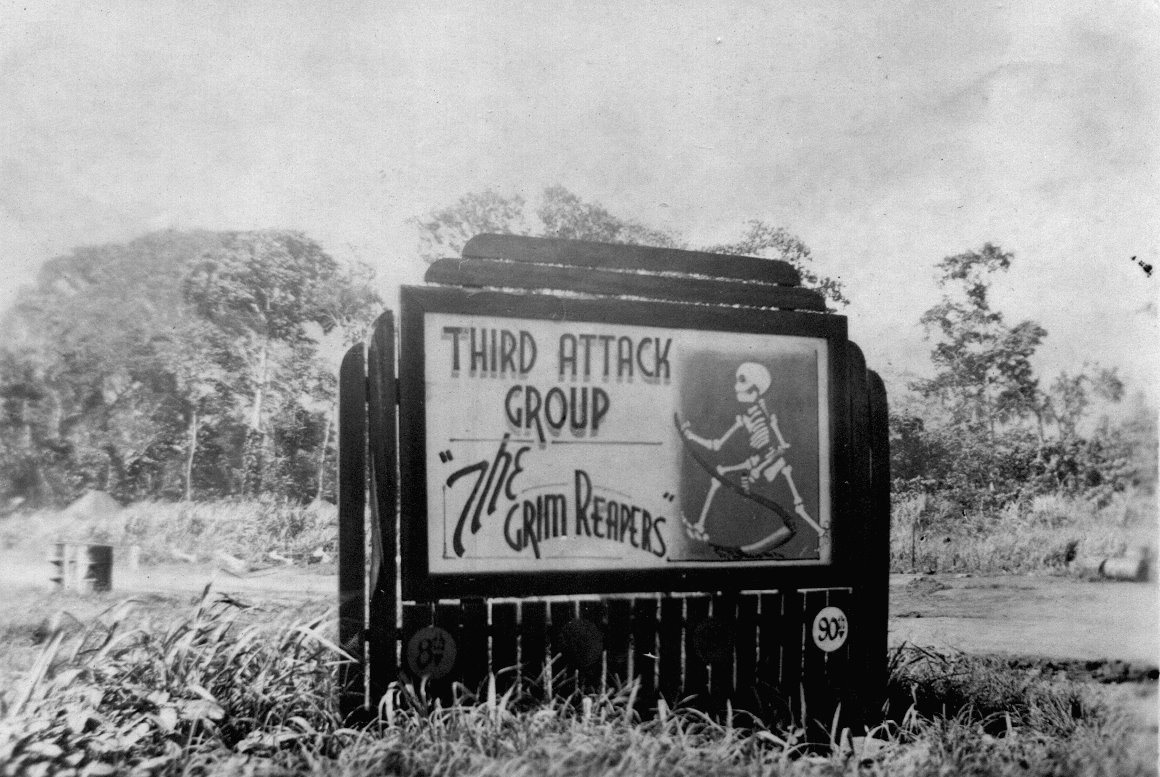
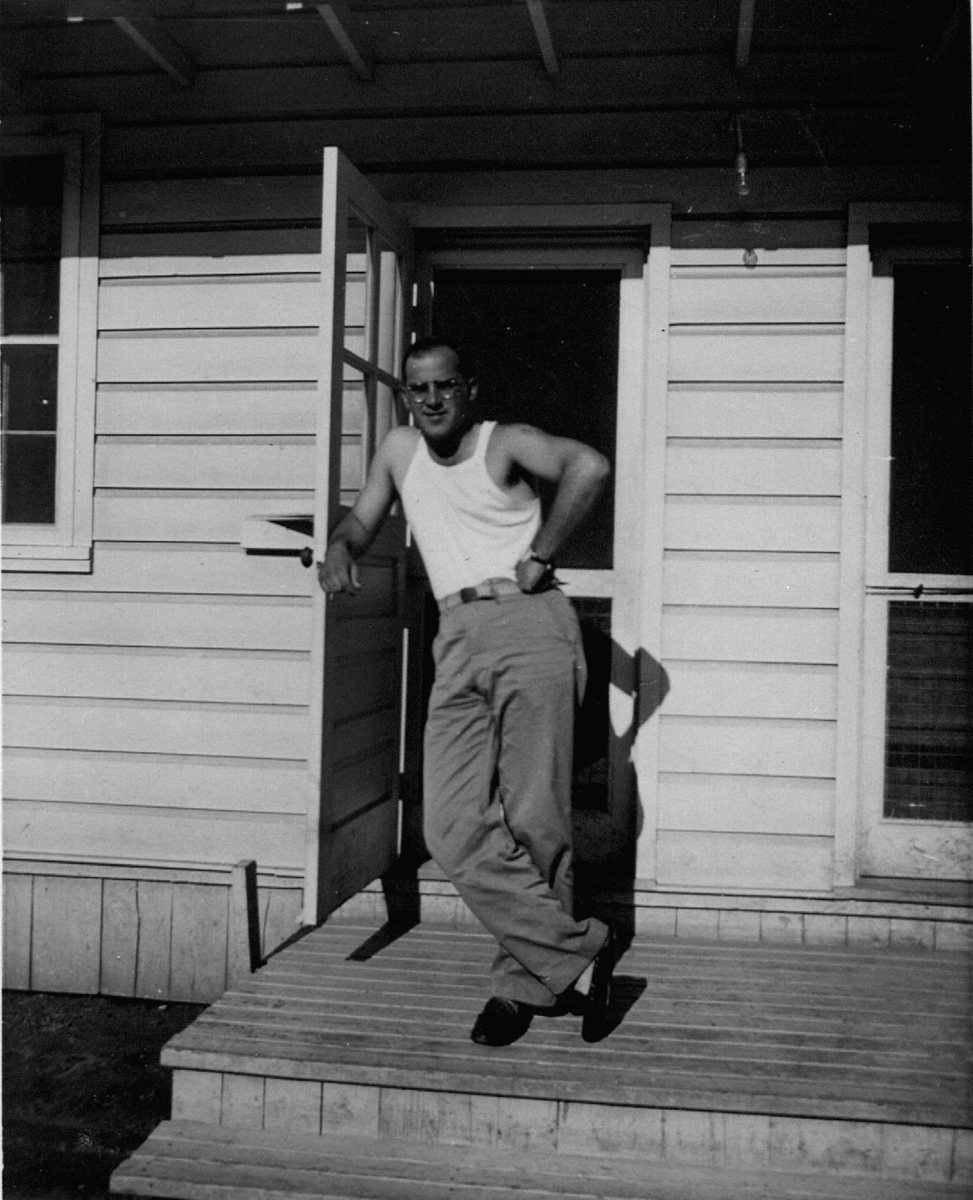
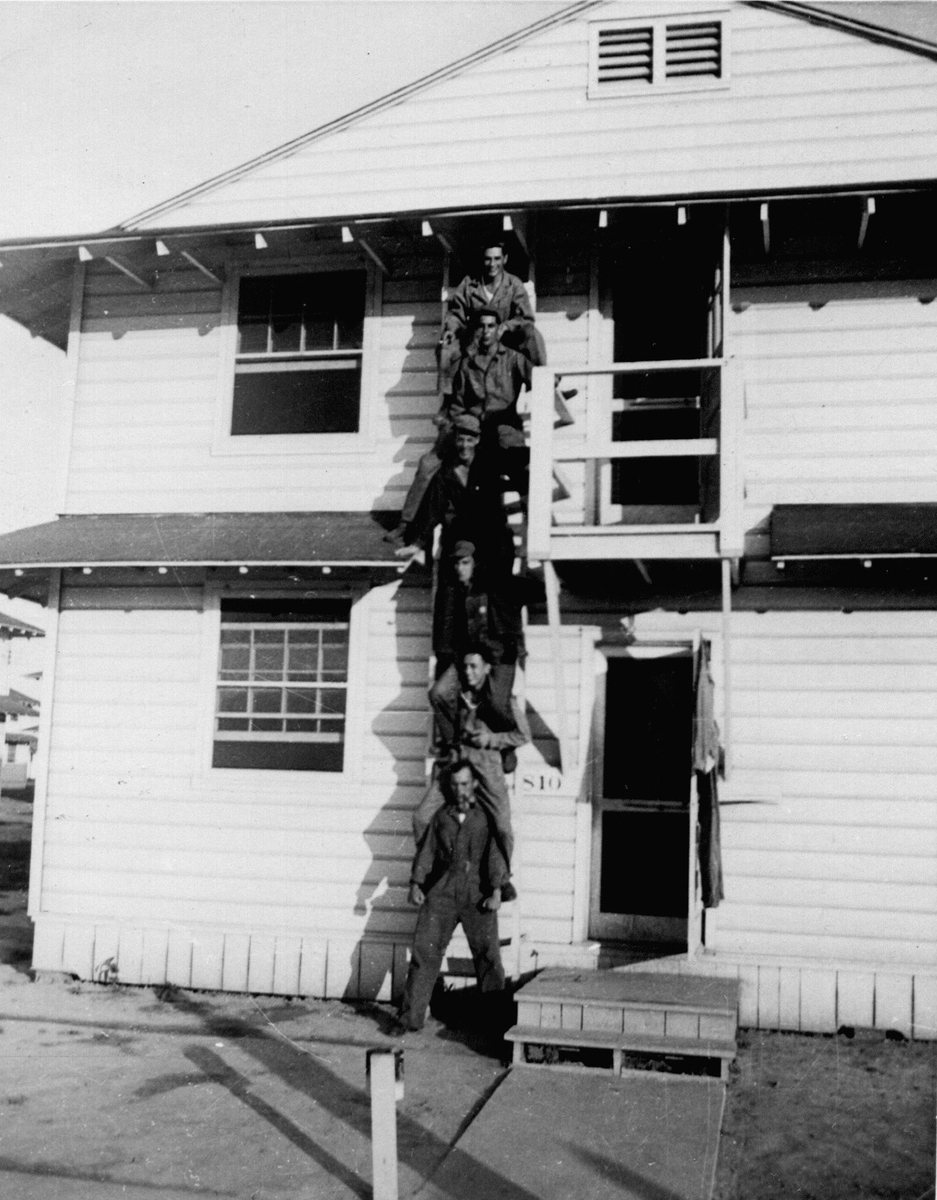
Okay, my name is Allen Sweigert. Born September the 9th, 1918, in Cressona. Cressona, Pennsylvania. Went to the Cressona schools. Graduated from high school. Graduated from high school in 1936. It was in the midst of the Depression. There wasn't too much doing in the town. I did get some part-time jobs. And I also enlisted in the Pennsylvania National Guard to get a little extra money. We had to go to weekly drills and summer encampment. And I belonged to the Guard from 19... Late 1936 all the way up till 1940 when we were mobilized into federal service. We went to a camp in Virginia. Camp. And then stayed there a while. And then we were moved to Camp Stewart in Georgia. After about... I guess it was about nine months into that. In April of that year... Yeah, it's positive. In April of 1941, I got discharged from the National Guard and enlisted into the Army Air Force at Savannah, Georgia. And I was assigned to the 90th Bomb Squadron, 3rd Bomb Group. And shortly after I enlisted, I was sent to the radio. And I was sent to the radio. And I was sent to the radio school in Scott Field, Illinois.
J
What did you... Did you pick the radio? I mean, how did that come about?
A
I was in... I had been taking a home course, mail order course at home. And I was interested in being a radio man. So they sent me up there. It was, I guess, maybe June up to about October. That year. And then I returned back to the squadron at Georgia.
J
What did you... What did you like about radio? Why did you choose radio? What was your main reason?
A
You thought, well, radio sounds like something I do.
J
What...
A
Yeah, well, yeah. I was thinking about maybe being a radio repairman or in civilian life once I got out. And I did, of course, in the service center, we were doing radio, some radio repair. We were doing the equipment. Of course, at that time, radio was the main... Oh, yeah. There was nothing like television in those days. No, no. So if anything was for your future, radio would be it. Right. That's right.
J
Where were you and when did you first hear about Pearl Harbor? Actually, before you say that, did you know anything was coming? Did you think that you were going to be deployed somewhere?
A
Well, even in the National Guard, before we were mobilized, we went to... summer maneuvers up in New York State, and not the customary two weeks time, but this time it was three weeks, and we sort of sensed a feeling that something was brewing somewhere. And we know the relationships with the Japanese was not the greatest, so we figured something was going to happen down the pike.
J
What were your personal feelings on that? Were you dreading that or...
A
We didn't think too much about it, really.
A
I don't know, we just, if it happens, it happens. I mean, and now when I got out of the radio school, back to the squadron, I was only back a short while, and we went on maneuvers. with the regular army at Fort Bragg, North Carolina. So after that was over, that was it. I think it was in November of that year, and then on December the 7th, I had the weekend off at Savannah, and I decided to go over to Camp Stewart, Georgia, see my old buddies in the old outfit. And while I was there chatting with the lads in the tent, a guy come in and says, the Jets just bombed Pearl Harbor. Well, okay. And then very shortly after that, another one of my buddies come back in, he says, do you belong to a third bomb group over at the air base? I says, yes. And he says, well, you're supposed to come back to the base immediately, all members. So that wound up the visit and back to the base I go. Just like that.
J
So how long was it until you were deployed overseas?
A
Okay, now, from then, then things were, it was real hectic, and it was a lot of indecision, it seemed,. from the higher-ups, because you didn't know what was going on. They got back to the base that day, and already they had some of the lads digging foxholes for fear of some kind of an air raid. And then they moved us from Savannah up to Augusta, Georgia, further inland,. and they weren't there too long until,. I believe they were,. they separated us, and I was one of what they called a cadre to go to Palm Beach, Florida, and form an anti-submarine group to show you how the indecision was. We got down there one day, and the next day they sent us back, back to Georgia. And they get back there, the orders were we're packing up to go to San Francisco, we're going overseas. So we packed up. Got on a train, took a ride back over to San Francisco, and we were there, yeah, maybe, maybe three, four days, and then we boarded ship, and started out not knowing where we were going to go.
J
You had no idea where you were going to go?
A
No idea.
J
We, there was a lot of speculation, are we going to the Philippines, are we going to Hawaii?
A
We had no idea where we were going.
J
Let's backtrack a little bit.
A
Family. Family. One day they, I mean, obviously they knew you were going over there, and obviously,. Gram and Katherine, how did that all come about, like breaking the news, and how did
J
they feel about it?
A
Well, they were, they were quite worried. I got told, I don't remember if I called a telephone, or did I just write a letter, I guess I called on the telephone and told them that we were going, going to, we were going, West Coast to get on, to be shipped up, and I says, I don't know where, I says, somehow I'll try to let you know where we are, but I, of course, I figured everything would be censored from there on, so I wouldn't be able to tell them exactly where we were going. They had, what I did, I had some kind of a little code, that I could say, like, dear mom and dad, or dear mother and dad. I wrote it out. Dear mom and dad, we're going to, that means we're going to Hawaii. Dear mom and pa, we're going to, this, different, different, same way with, with my wife, girlfriend at that time. It depends how I address it, you know where we're going to go.
J
How long, how long were you dating Gram at the time, before you were a?
A
Well, we started back in, maybe, 38, 39. Maybe about two years, a year and a half. Boy, that must be something to get up and out of your home and just, yeah. All right. Well, what, now, you weren't, going, going overseas, of course, we were over in a big convoy out of San Francisco. I don't know how many, up in the teens, I don't know how many ships there were, and,. you know, one morning, one morning, we, we woke up. We looked out. There was only half of them there. Some of them had broken off, and where they went, I don't know. They went to some other place, and, and then, maybe the next day or so, we look out in the horizon. Well, the destroyers were quite busy going around, and looking out in the horizon, here comes a, another group, and joined us. Then we had a big convoy. There, there were instances where there was alerts on submarine, uh, attacks and all that. Eh, eh, it didn't take much of it. Uh, and then...
J
What else can you tell me about, uh, the trip overseas, not knowing where you were going, and just being on this ship?
A
Well, it just, just... Because that must have been at least, you know, a few days. Yeah, we left, uh, we left, uh, San Francisco on January the 30th of 42, then got to Brisbane,. Australia, February the 25th. So, it was quite a lengthy trip. The day before we got to Australia was the first time we knew where we were going. Uh, we were up, we were up, up topside on the deck. Most everybody up, was upside, up there. And, uh, announcement came over, this is your captain, uh, he's going to inform you that barring any, uh, uh, unforeseen circumstances or trouble, tomorrow morning you'll be looking at the friendly shores of Australia. And that's the first we knew. We knew where we were going. Hmm.
J
What'd you think about that?
A
Well, that, that sounded all right.
J
Let's get off this, get off the water.
A
Yeah, let's get on, put your feet in the ground. We're quite happy about, about that. All right.
J
So, you land, uh, you land on Australia, and what's the first thing you do there?
A
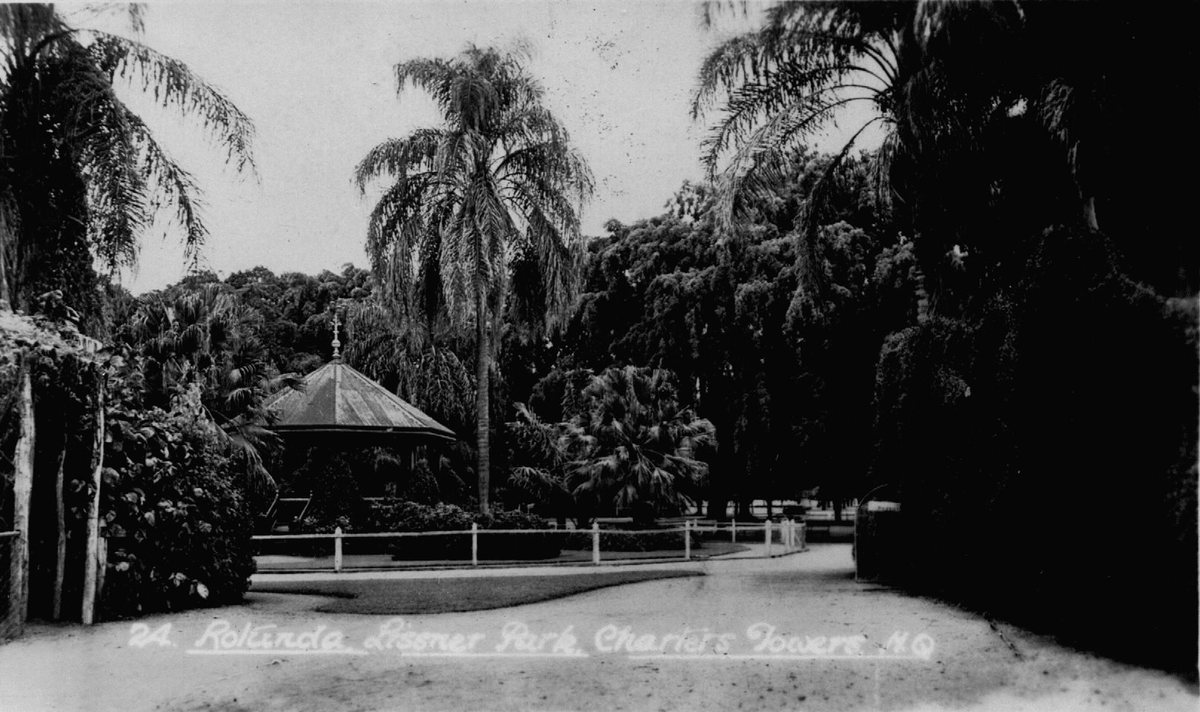
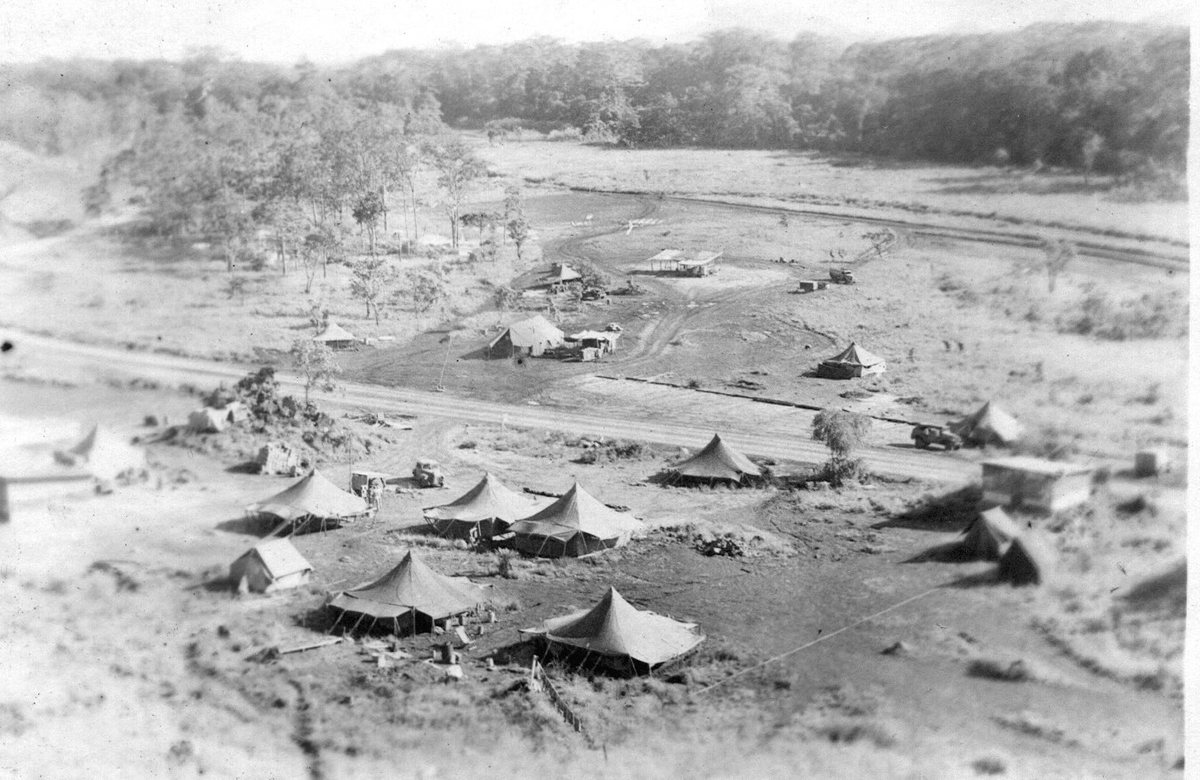
First thing we do, they, they, they put us in a, in tents on a, at some racetrack. And, uh, there again, then it was, then it was quite a time getting used to the, uh, the Aussie money. And, uh, then, of course, there was some Australian troops there, too, we mingled with. And it was quite interesting listening to their lingo. And, and they're trying to understand us. And because we come from all, every state in the Union, I guess, everybody seemed to have a different dialect or whatever you want to call it. Uh, so you, you go to the PX and you give, you give them a dollar or a five dollar bill and they'd come back with a, a bunch of things. Uh, and, and, and all that stuff, if they had, you know, had a lot of, uh, uh, nets, uh, uh, uh, pond notes and adds shillings and florins and all that kind of stuff and you didn't know what you had. Now I got used to it and, and then, uh, after they had the, the, the, uh, ship unloaded, I might add there, too, when they're unloading the ship when it comes tea time, eeh, everything seizes. And we're gonna have tea. But once the ship was unloaded and everything was, then we, they put it on a train, everything was put on a train. Uhah. and at that time you went so far because we understood each state or province in Australia had a different gauge track. In other words, the trains could run so far then you had to take stuff off and put it on a train to run on those tracks. So we went from Brisbane up to Tonsville and then again we switched things up and went west to Charters Towers, a small town about 90 mile inland. We got there, looked around, put us out in some kind of a field or some scrubbed trees grew there, very dry, dry season and the ground was baked real hard and there we were, well,. where's the airfield? There isn't any yet, we're working on it. There was no airfield but here's an Air Force outfit with no airfield and besides that we didn't have any planes. Our planes from Savannah, where they went I don't know but they didn't go with us. So we're over there and I might add too that it's only about one-third of the original squadron. That arrived in Australia. The others were broken up and some went somewhere else to form new outfits or whatever because they had to train people in a hurry.
“There was no airfield, but here's an Air Force outfit with no airfield, and besides that, we didn't have any planes.”Allen E. Sweigert
J
How many people do you have estimated in your troop? Estimated?
A
I had 130, 150 when we got there. I know that our radio crew we had, there were six of us, normally we had about 20 and. in Savannah and no planes. But then we finally, they finally gave each squadron, I think it was, we each got one. And what made it interesting, these planes that we got and later on we each got three I think it was, these planes had the Dutch Air Force markings on. They were originally consigned to the Dutch Air Force in the East Indies. The instruction pamphlets that came with it was written in Dutch. My Pennsylvania Dutch didn't help too much, I'll tell you. So it was just, you know, the stuff looked the same so you just come up with your own ideas of what it was. Oh, wow. A little bit of dangerous flying there. All right, Battle of the Coral Sea. So there then we gradually then we got more planes and. two of our two of my buddies in the tent radio people they they lost one of them in a crash and then they lost the next one. So there was only
“The instruction pamphlets that came with it was written in Dutch. My Pennsylvania Dutch didn't help too much, I'll tell you.”Allen E. Sweigert
J
How did that happen?
A
Well New Guinea is a funny place when you try to come over the mountains over the old Stanley mountains, you've got to be real careful. And at the time we didn't have real good maps and everything. You could come through what you thought was a perfect map, but then you took a really heavy landing. You just got a hot air balloon, a Pass, and actually it was just a deep valley, and you come up here, and up here it's solid, and you're in there, and before you know it, you're up against that, and they crashed into the mountains there. So there was three radio guys left. You ask about the Carl C. Battle, well, of course the Japanese were real busy coming down through the Pacific at that time. They'd come down, and then they had the battles at Henderson Field in the islands right below Australia, and then we got word that the Japanese were going to attempt to land at Port Moresby in New Guinea, which would be on the west coast of New Guinea facing Australia, and they expected that when they came around there, they would possibly try to land there. They had a bomb like Townsville in Australia, which was just east of us then. So somebody got the, to us, a brilliant idea, a dumb idea, I guess you could say, to send,. well, they woke me up early one morning, it was dark, and they says, you're going on a mission. Okay. We get dressed, go out. They took us to... To the airfield, and there we stood. We didn't know, nobody seemed to know what was going to happen. Finally, a guy come out and said, what's going to happen? They expect the Japs to bomb, and if they come in there, once they leave, we'll take off from here and follow them out to sea, and you will send radio signals so the rest of the squadron can home on it and come out. Yeah, we're going to circle the Jap fleet. And I'm going to send radio signals. Well, all right, I know how to do that. But then, later in the day, another visitor to the airplane, and he says, do you know how to fire the guns? I said, I don't know anything about them. He said, well, we're going to give you a course on the lower turret, because you might have to be a gunner. So I got a real fast 10-minute instruction. Period on how to work the twin .50 caliber machine guns in the lower turret.
J
What were your thoughts when they were telling you all this?
A
Well, like all of us in the crew figured, well, this is it. This is a suicide mission. There's no way anybody's going to come back after this.
“This is a suicide mission. There's no way anybody's going to come back after this.”Allen E. Sweigert
J
So then what happened?
A
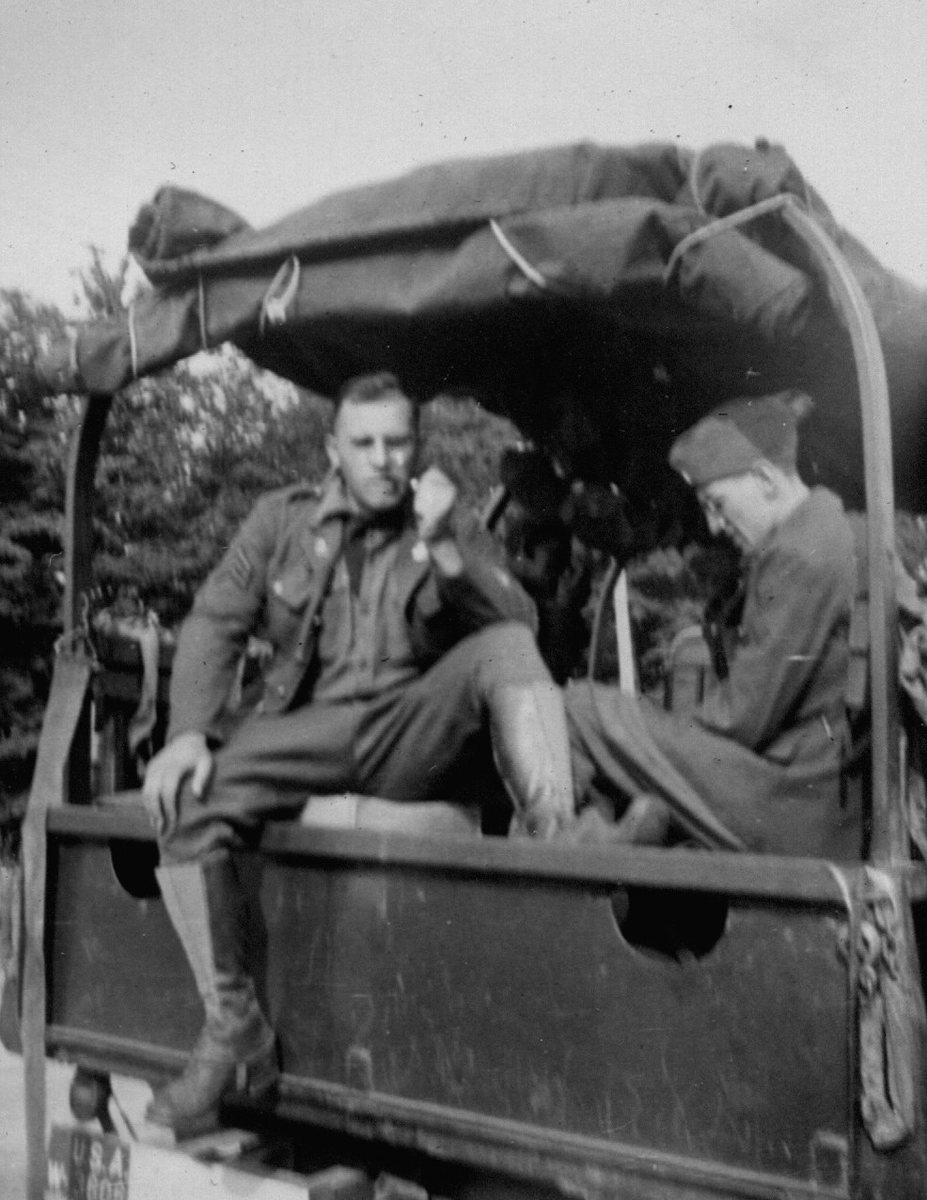
Well, they, we were there. We sent out that airplane for. I guess, I don't know, it was two or three days like that, just waiting for things to happen. And it was kind of a long day with nothing to do except just sit there and waiting. And every time you heard a truck or a car coming, you figured, oh, here it comes. And it was nothing. But then the one day they come out, and they said, which one of you guys is flying? I said, right here. He says, how do you feel? I feel all right. Why? He says, are you still sick? I says, I'm not sick. And then I, the two of them said, let's get out of here. And away they go. Later on, I found out that my communication officer had tried to get me off because of the shortage of radio men and have one of the guys from headquarters go out and do the radio work. Because they were well stuck. We weren't. So, but that didn't work out because they didn't notify me that I was sick. No, it stayed the same. Well, the Jap fleet was intercepted in the Carl Sea by our Navy, and the battle ensued there, and they never did get to their destination. So, basically, that guy that was supposed to relieve you pretty much was hoping that you were not sick, and then pretty much took off.
J
Is that basically what that was about?
A
That's what it seemed like, yeah. Like, to hell with that. I'm not staying. Yeah. He says, let's get out of here. I said, okay. Well, in the meantime, I'm staying there not knowing what's what. All right.
J
How'd you end up in New Guinea?
A
Well, we operated out of Charter's Towers. They did some, a lot of reconnaissance flights to find out what the Japs were doing up along the coast. They even went to Darwin in the northern part of Australia, and they flew up into the Philippines at the Japs' landing. They flew up into there at some remote airfield, and they conducted some raids, and then they brought back as many experienced flyers or air crews that they could possibly haul in the ships and came back. And then we'd operate out of Charter's Towers, fly up across the Carle Sea into Port Moresby, and you would stay there for a while until... The Japanese, their reconnaissance found out you were up in there, and then they'd start raiding, and you'd be on the safe side. You had to pull your planes back, because there wasn't too much defense there. When they walked, they would ask for volunteers to go along with the crew to service them and everything. And I did, there was three of us that were pretty friendly there, and we volunteered to go. And it was interesting, to say the least. And then we'd fly back, and, boy, we weren't back too long, and if they were going up again, off we go, we'd go back up again. Well, the one return trip was rather hectic. Going along, and it was a beautiful day, and flying over... And looking over, and you're over the Carle Sea, and you look down at those Carle beds, and it was really beautiful. It was the first time I'd flown over the Carle Sea and it was the first time I'd flown over one of those Carle Beds, and it was just a beautiful moment. I mean, I remember, the first time I'd flown, I was in the Carle Sea, I was in the Carle We're going back, and you can see a big cloud formation looming up way up ahead of you. And the fact that it was interesting because the pilot, the two of us, the crew chief and myself,. sit in the chair and handle the controls of the plane. And I was the second one to sit there, and it was, you know, just have your hands on the control of the plane. But then it started to get too close to the storm, and he says, better let me in there, Al. So we're not equipped to fly over. It was pretty high. We didn't have oxygen for everybody, so you couldn't fly over the storm. And certainly we didn't want to fly through it because they're wicked. So they dip down. You're only flying, skimming up over the waves in the sea. You could see them lashing around. And we ran around the storm and got off course doing it, overland, and the co-pilot went 12th in there and he says, Boy, I don't know where we're at. And he says, Al, what do you know about this radio compass? Oh, I said, that's simple. I said, I know the frequency of the radio station at Townsville. I think at the time, I think it was something like 610. I think it was something like 610 KC's, and I said, we'll turn it on, and the needle on your indicator. towards the broadcast station, which it did, it was off to our right. So he said, well, if we go that way, we'll go back over to the sea again, Al. That's right, but let's try it. You go back over to the sea, and then this needle had come the other way. We approached Townsville, and sure enough, we come in right over the... Right over the dock in Townsville and landed there because we, at that time, we didn't have enough gas, so we had to stop the refuel, and they said, where have you guys been here? We figured you guys were missing, but then we took off from there and came back to Townsville. Now, these trips to New Guinea, yes, I feel awful lucky about that. There was a case where it was really wicked. Coming back, and then we weren't back maybe a week or two, and they asked for planes up in New Guinea again. We said, yeah, we'll go, and then the communication officer says, no, no, not this time. You guys made three trips now. Let somebody else go. It's not right, but you go all the time. So a whole new crew went up, and I'm working the radio that day in contact with the flights going up,. and I heard them say that number so-and-so just went in, which meant they went into the sea,. and there was one of the radio guys. If we had, if we'd have went down there, what plane would it be?
“Now, these trips to New Guinea, yes, I feel awful lucky about that.”Allen E. Sweigert
A
You'd end up, well, eventually you ended up in New Guinea. Yeah, then we drove all the way over to Townsville, loaded on a boat, and went up to Port Moresby and unloaded there. And then we set up, there was, I think, four airfields in New Guinea at that time. It was assigned to, they were named 3, 3-7, 14, and 17, I think, which was how many miles inland you were from the coast. We were going to 17, furthest inland, and it was a little strip, and a defense around it. It was difficult. It was a different place, cut out, called Revent, where you parked the planes. And then what you had to do, we were lucky, we had to set up the radio right away because you had to check out your equipment and try to work your, and those guys, it was two trees there. I remember you had regulations, how you had to put up an antenna. Yeah. It had to be so many feet long, and then where you tapped in, it had to be so, so. So I said, go up there and just make a tap, and we'll see what, just enough that we can have radio signals here between the base and planes on the field. Just to check out the radios. Well, would you know that, that worked like under the tree, because it worked good, and I could work the planes on the other side of New Guinea or across the mountain. And we were the only squadron that could. And we were the only squadron that could do it. And then the one day, they'd come around, they'd inspect your, and he says, oh, it's no good. He said, you have to tear that down, he said, and put it up according to the book. And our officer says, you don't get anywhere near that. We're the only squadron in the group that can work the planes on the other side of the mountain. Hands off. So why it worked as well as it did, I don't know. Because it was against all the rules. It was against all the rules of whatever. Yeah, too bad. Yeah. Living conditions. Natives.
“Our officer says, ‘You don't get anywhere near that. We're the only squadron in the group that can work the planes on the other side of the mountain. Hands off.’”Allen E. Sweigert
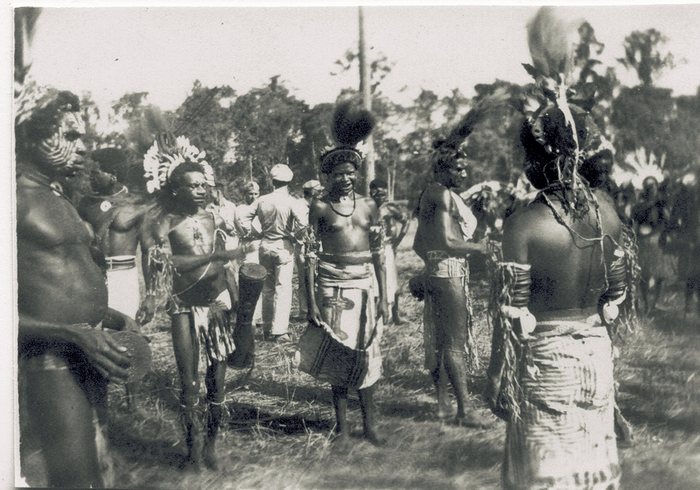
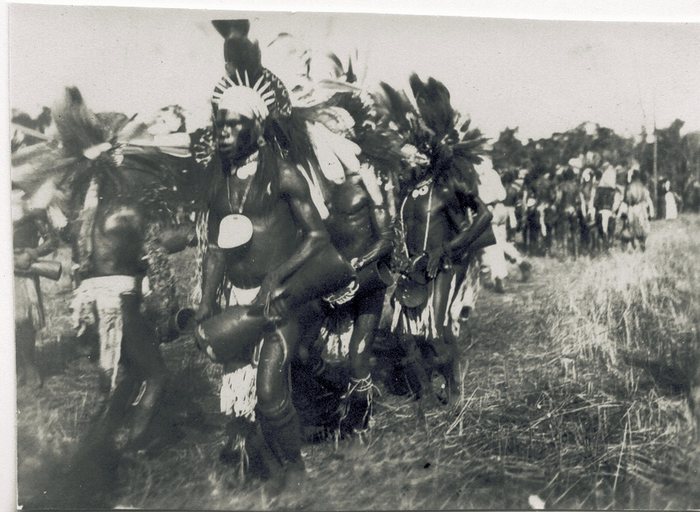
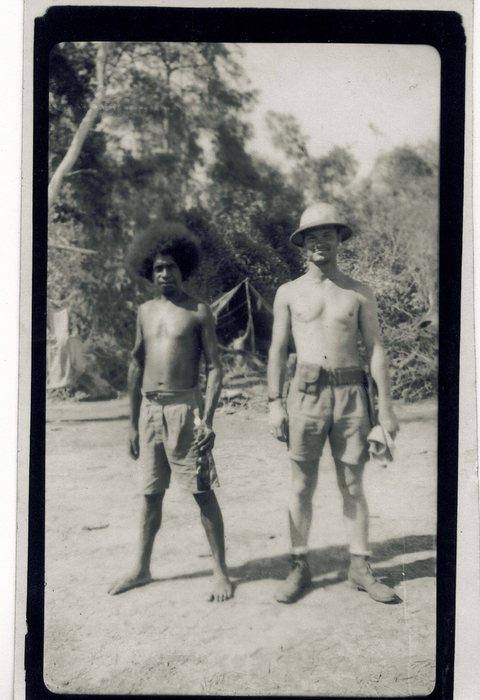
The People of New Guinea
Allen's own photos of the New Guinea villagers his unit encountered.
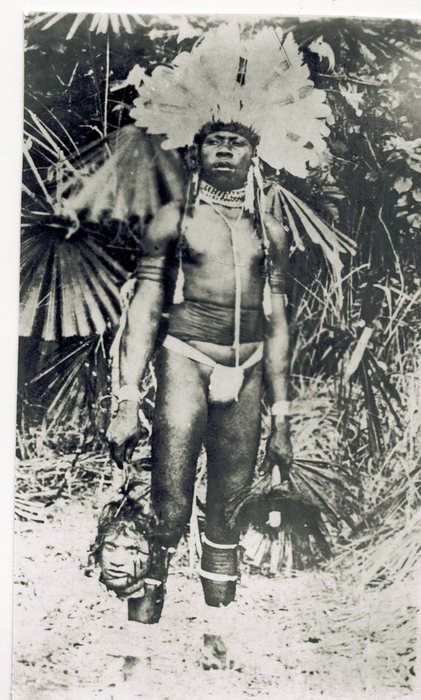
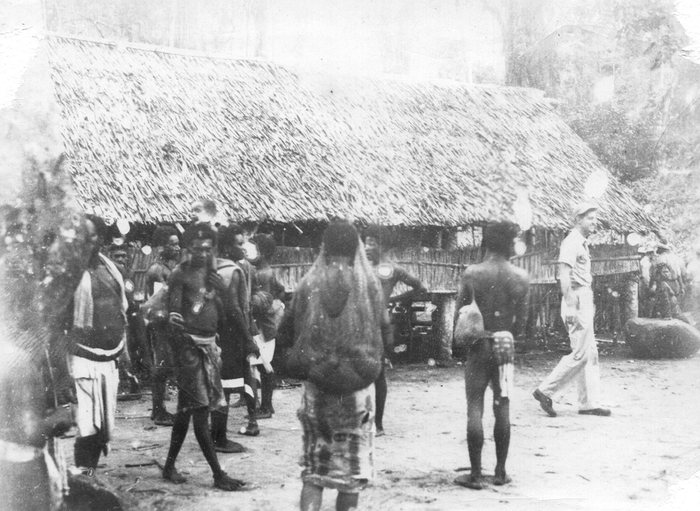
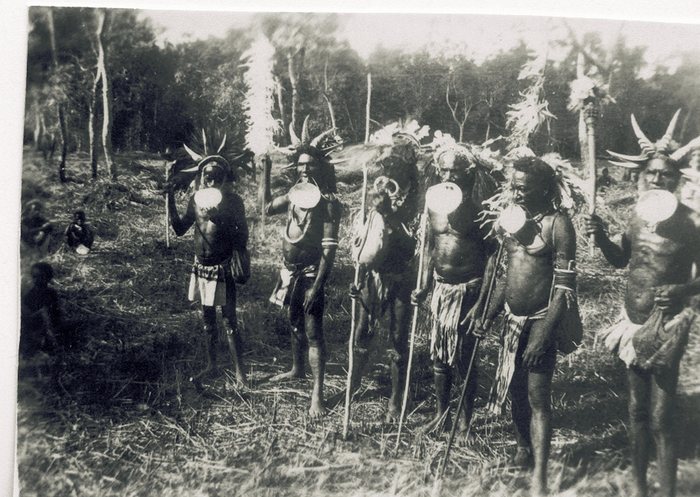
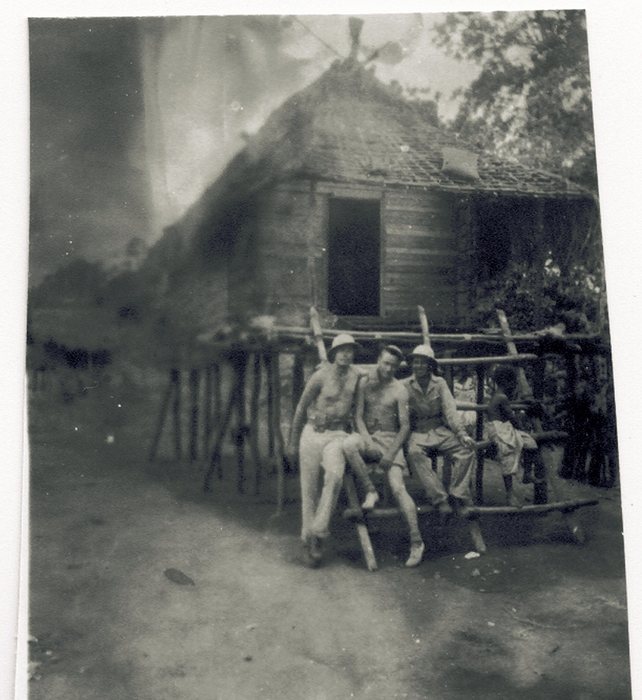
J
How you got up there? How you ate?
A
We elected not to stay in the camp area. The guys in this one, I guess there were four, six of us. We said, no, we don't want to stay in the camp area. We'll stay at the tent where the radio equipment. It is right along the strip with the air crews and the mechanics. Most of those guys, at least the crew chief and a couple others, they had their tents out there. You were close to that. So what we did, you can't put your tent up here, they said. What we did, we built a, there was a big irrigation ditch we had dug there. We got a tree, felled a tree. We didn't put it over there. We made a little bridge and put our tent over right in the jungle. You put your cots in our little platform. It was a little bucket of oil because if you didn't, the ants would crawl up and join you in bed.
J
These aren't regular ants either, are they?
A
They're regular big ones, yeah. So. And everything, and it rained. Well, of course, it rained all the time, it seemed. And you're always slogging around in mud. Mosquitoes were in droves, you couldn't believe.
J
Did you want a break for lunch?
A
Yeah. Yeah. All right. That took me cold. All right.
J
What do you mean the mosquitoes?
A
Like you wouldn't believe.
J
You got bit pretty much regularly?
A
Yes, yes. Going to bed at night was an ordeal. But I didn't undress. Outside your bunk, you had a mosquito netting that you fit over the bunk and what you would do is get something and swoosh around there and get them away from there and then you'd quick dive in under the netting and you'd undress and then pile your clothes along the side, hold your light up at the mosquito bar, you could see there they were, all lined up waiting for you to roll over against the netting. It's crazy. Yeah. Even in the daytime, in the radio tent, you're sitting there under the table and you're always swatting that at your legs because you're lucky enough to have a movie some nights up in the hill.
“Hold your light up at the mosquito bar, you could see there they were, all lined up waiting for you to roll over against the netting.”Allen E. Sweigert
Off Duty
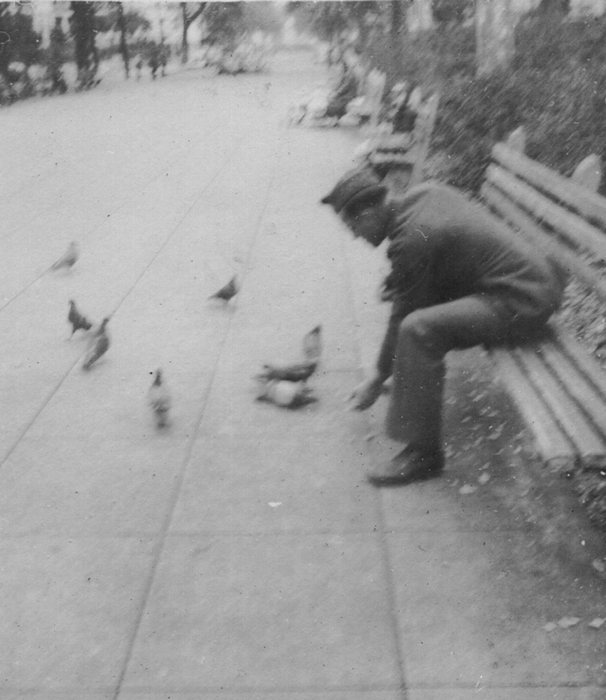
Allen's own snapshots of the lighter moments — hunting, a pipe, feeding pigeons on leave.
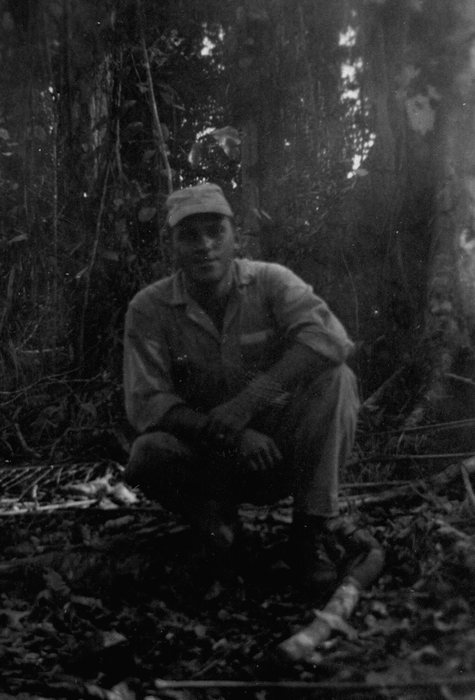
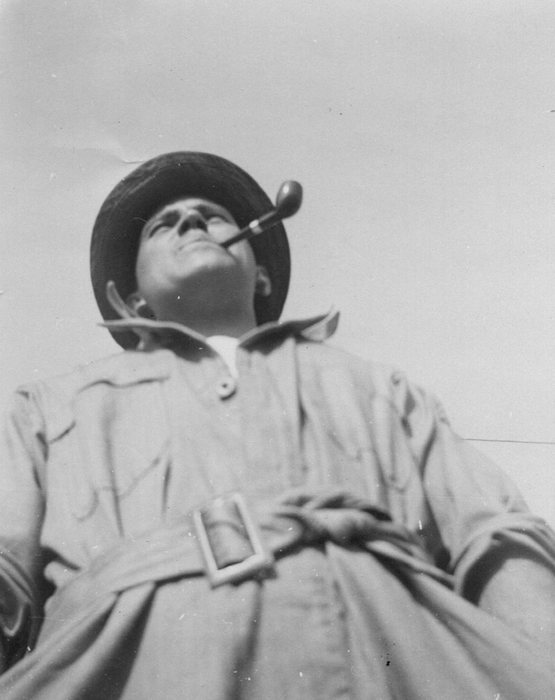
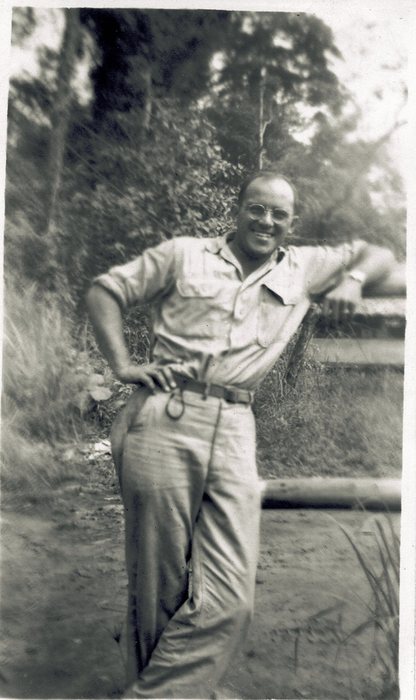
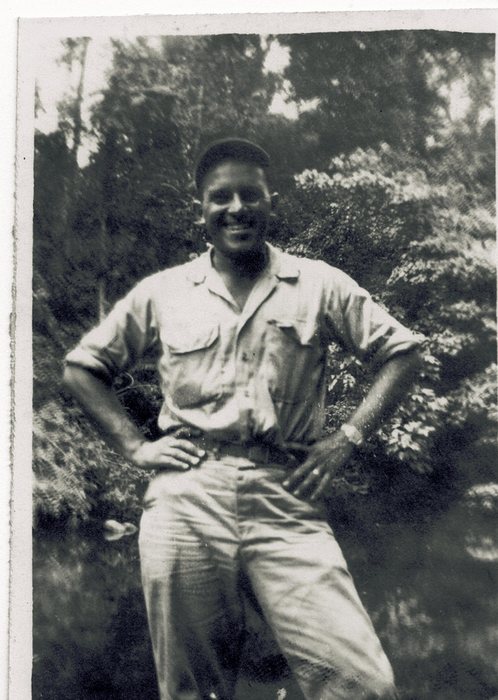
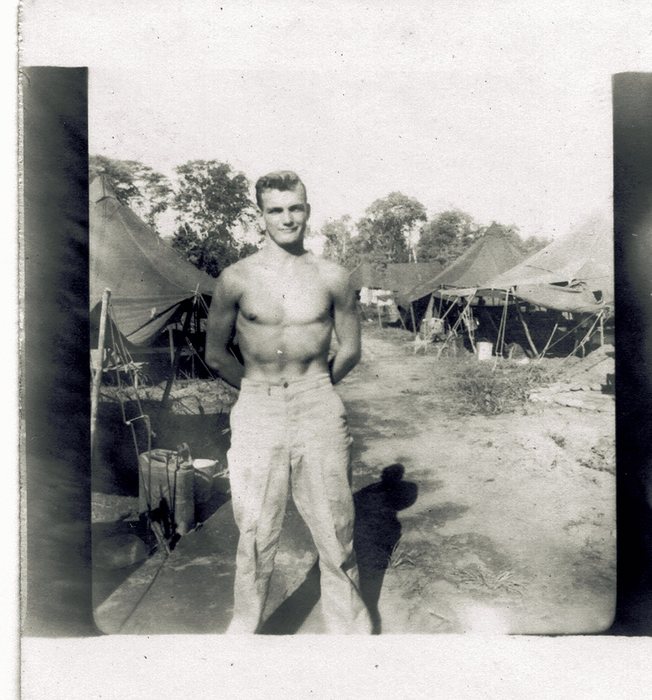
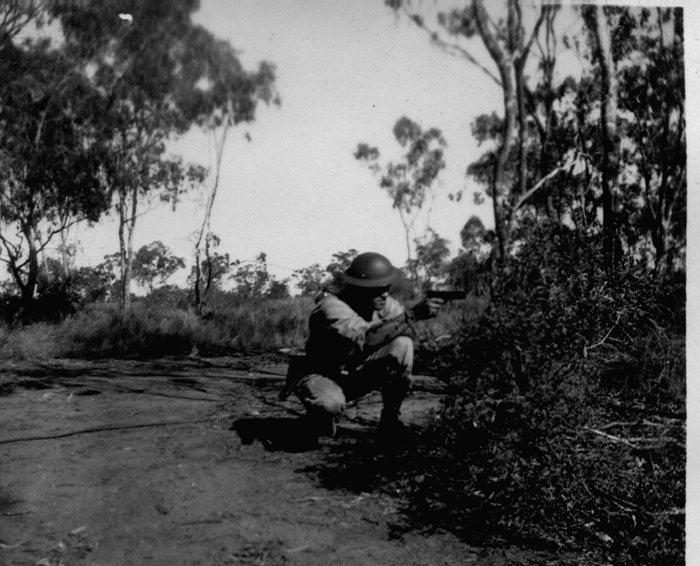
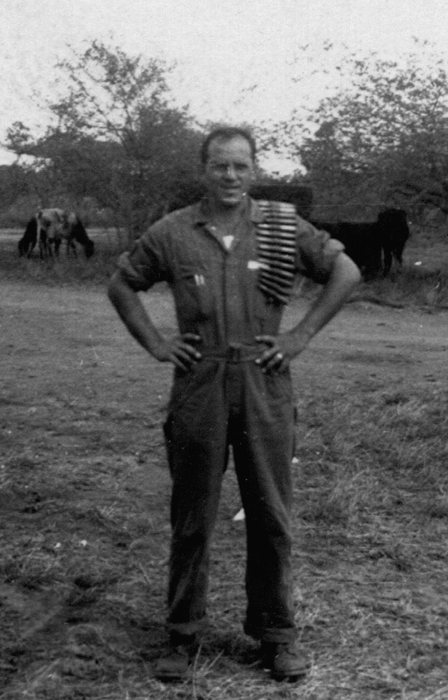
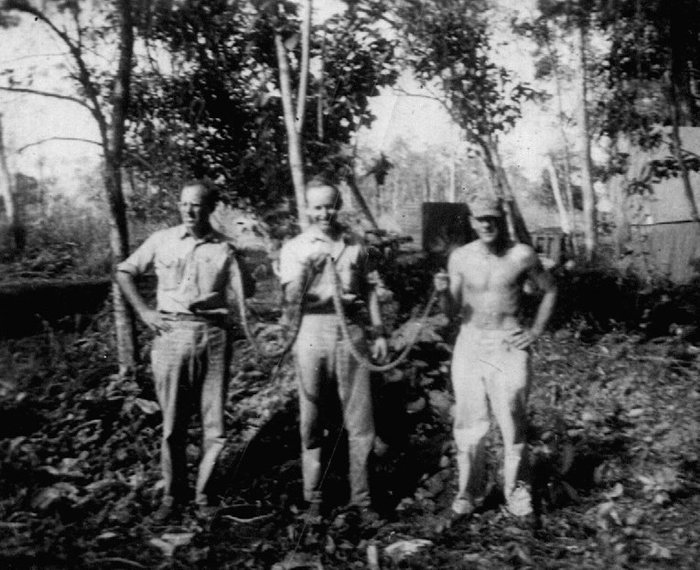
J
What kind of pictures did you see? Well, what did the movie tent look like? How was it?
A
The screen out there was no tent. There was a screen out there on the hill. You were sitting on the side of the hill looking at it. You might have watched it. You might wear your raincoat if it was raining or not just to keep mosquitoes off you.
J
What kind of pictures did you get to see?
A
Oh, they were, they were just the first line at the time. I don't know the names of it anymore. Yeah, you had to see good things. It's something to see when you're halfway around the world in the middle of nowhere, I imagine. Oh, yeah. You get to appreciate things. You betcha. The one, the one place we had our tents, it was platforms. They did that at Quartermaster or somebody. Whoever went ahead of us, I don't know, made platforms and then you put your tent up in the platform. You were up about maybe three feet off the ground, maybe four. People were waiting in the crimbers. We would notch into the jungle to get bamboo. And you learned the technique. Cutting these bamboo shoots and stripping them and then you'd wind up with a bamboo floor in the tent. The tents didn't last too long because of the rain and the humidity and everything. It sort of rotted away and shorted. What you'd have is the tent above you and then you had a frame over your bunk. And then maybe you'd have another piece of old canvas or something. Something over the top of that because no matter how rainy it would drip, drip, drip, and you just kept additional coverage over you like that.
J
What about the natives?
A
They were friendly. They were quiet. They didn't mingle. You didn't see too much of them, really, except certain times maybe a couple of them would be walking around looking for something. I don't know what. But it was interesting. The male of the family or whatever they were, he walks along with just a stick, like a cane. And the woman, she has to have a baby in like an orange knitting hanging around tied to her head somehow or other and down the back. And maybe some kind of a packet, kind of all this stuff they picked up. He's going along doing nothing.
A
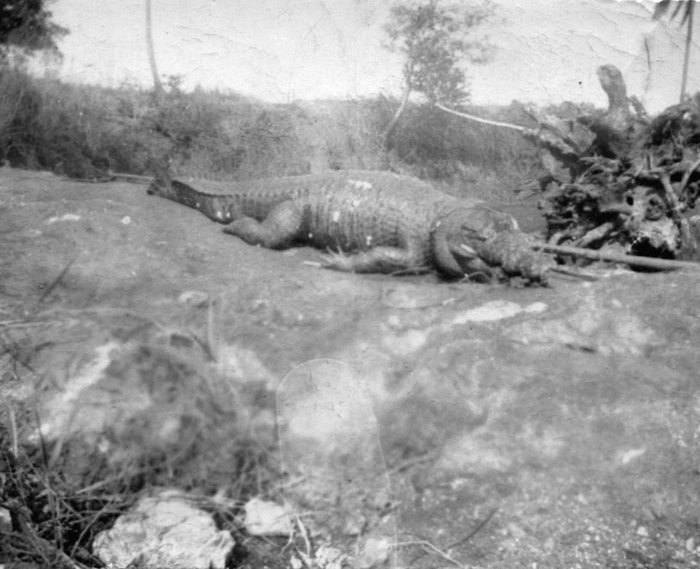
That's interesting. We made several trips up to the native village to see how it was. The first time, this is something that you might have seen back in school in the National Geographic magazine or something, you know. And you couldn't imagine that humans were living like that. Probably still live like that. I don't. And we often wondered what they ate because you go up in the village and you didn't see anything. There's no signs. There's no signs of any garden or anything. They said, well, they ate the wallopies, which is a small version of the kangaroo, and wild boars, which we never saw. We never saw any. They did kill a crocodile up behind our camp one time. And we went up to see that. It was laying on the ground above the pool that was there. And the Australian that was with us said, what they do, they haul that out of there and they'll let it lay there until the evil spirits are out of it. And then they'll haul it up to their putts and then cut it up.
“The Australian that was with us said, what they do, they haul that out of there and they'll let it lay there until the evil spirits are out of it.”Allen E. Sweigert
J
Eat it?
A
Yeah. That's got to be dangerous. I mean, letting something out there rot before eating. Yeah. We had different reports that came up. You move into another territory. You've got... I'm not sure what to expect, what language they used. Most of it was Pidgin English. Along the coast there, these natives had got in contact with the missionaries before that. They were partially civilized, I guess you could say. You'd find out what kind of a disease is to expect in there. I don't know. One place we went into where they said the life expectancy of that tribe was about 32, 34 years.
“One place we went into where they said the life expectancy of that tribe was about 32, 34 years.”Allen E. Sweigert
J
You never went too west into the New Guinea jungle, right?
A
No.
J
And why was that?
A
Well, it's a known fact that the western part of New Guinea, there's not even headhunters still. I might add, not too far from where we were either. Anything that was going on up until that time, coconut groves and all that kind of stuff. All that stuff was... The coast. And the missionaries had these different stations along with them. This is where these people were. But even today, and I know not too long ago, this one of the people were in Western New Guinea,. that they ran into a place, I don't know what expedition went in there, and they found animals that never knew existed. Sixty-some years later, still uncharted. There was nothing there when we went in there. They weren't doing anything like that. There was no other construction going on. Now I read about three-, four-story motels and all that kind of stuff in there.
“They found animals that never knew existed. Sixty-some years later, still uncharted.”Allen E. Sweigert
J
In New Guinea?
A
Yeah.
J
What dangers did you face in the jungle?
A
I mean, besides the obvious, you know, don't go west. Well, malaria was our greatest enemy. I mean, when I thought that, I could... I contacted that, spent some time in the hospital over there. It's a wicked disease. I mean, you're really sick when you get that. But the same token, there was another fever, dengue,. which is similar to, well, not as bad, but when you got sick with it, at first you didn't know what you had. You had dengue. You understood it. Malaria, you have to catch that on the onset. It proved that it's malarial.
“It's a wicked disease. I mean, you're really sick when you get that.”Allen E. Sweigert
A
You had to be careful of your feet, you know, getting wet all the time. And then we, I know I had to get there. You reported back to the medics, and they put some kind of solution in your ears. You didn't get fungus in there.
A
We had to have a telephone responsibility.
J
You had a telephone responsibility in the town?
A
Well, yeah. In the department, they not only had to service the radio equipment in the planes and have a ground radio station,. they also had to lay telephone lines between all the operational buildings and certain tents for some of the crew chiefs or the people in charge. So we had to... And a guy... I had one antique as you look at it today where little flappers would drop down when a call came in and you'd take the cords and put it in there and then you'd take another cord and plug it into the party where they wanted to take a crack and ramp it with operated telephones
J
You had to keep lines open or something like that?
A
We had to string lines. We were quite a chore stringing them in Australia. because the ground was that hard you'd really have to dig or sweat to get across a road, a dirt road. You'd try to get up on the trees and swing them across. Most of the time, like in New Guinea then, you'd get them off the ground a little bit so they weren't laying down and they weren't wet or in the mud. Just get up out of the way. I imagine that was an important responsibility. Well, yeah. The group headquarters in charge of the flights in our squadron. when I talked to them, well, that all had to come through and then he had to call into the different officers' tents to get these guys scrambled to get down to the operations tent so yeah, it was very important
A
Radio stories in the jungle
J
Anything that sticks out?
A
Radio stories I don't have any stories that don't work on the radio in the jungle Yeah, one unfortunate Yeah, we got the call that the guy was coming in and his landing gear wouldn't come down he had to have a belly landing so I'm on the radio, I reported it to 101 flight with our pilots and he come over. and. I said, what should I tell him? He said, tell him to go to, I think it was the 7 mile strip and come in on the dirt, not the metal strip, the dirt strip. And I got ahold of the plane, that pilot and I said, you are to land at 7 miles on the dirt strip, not the metal strip Repeat. He says, right he says, I'm going to land on the dirt strip. Okay. We'll have the emergency equipment. And you're coming in and following him in, he's approaching
J
What did he do?
A
He would come in on the metal strip. Just like hit it and slide it. Right off the runway and one car was killed
A
Crucial moments. Crucial moments Crucial moments
J
What do I mean by that?
A
I'll tell you one the day we got the red alert, the enemy aircraft approaching within three minutes of the airfield Everybody figured out where they're going to hide, where they're going to jump in the hole or what. And nothing happened, nothing happened in three minutes, the five minutes and by the ten minutes I think. And nothing. And we're all standing up there How come we didn't get an all clear? And all of a sudden, you know what? Somebody looked up and said, that's why we didn't get the all clear and there's a squadron, a flight of Japanese bombers and fighters they estimated about a hundred right above us Went over the airfield and went down and hit the next two airfields Not ours, but a few of them and I understand there was quite a few airbags down near Port Moresby at the time
“Somebody looked up and said, that's why we didn't get the all clear. There's a squadron, a flight of Japanese bombers and fighters. They estimated about a hundred right above us.”Allen E. Sweigert
J
What were your thoughts at that time?
A
Words exchanged between people. Well, I mean, you look up and you see about a hundred planes
J
What do you say to each other? What do you do, you know?
“Into the ditch. No messing around, let's get in. Forget about the water and the mud in the air. The mosquitoes, into the ditch.”Allen E. Sweigert
A
Into the ditch. No messing around, let's get in Forget about the water and the mud in the air the mosquitoes, into the ditch. Well, I guess that kind of falls under the same category as close calls Yeah, I would say
J
Do you have a close call?
A
No, not really
J
When you come under a close call
A
Well, it would circle the airfield and what was the camp there they never knew when or if it was going to drop any bombs. And they just let them fly up there they didn't put any attack up on them or nothing. They had searchlights, they didn't put them on
J
Why give away the position?
A
They left the joker circle up there and you never knew how many people they were holding. I don't remember it it never hit them Me neither Well, communication with home, letters back and forth
J
Can you remember anything about that? How you received your mail? How you sent it out? How often did you do it? How often did you get stuff?
A
You never knew when you were Every letter had to be dropped off at a tent. You had to read it over and then send it out you had to leave your envelope unsealed. And then they'd come up with what they called V-mails it was something that they could send it out in miniature form it wouldn't take up as much room on the ship. And the mail went out and then they'd call me Well, you may not get mail for a while They'd all want you to get a whole bunch of them. Especially like newspapers or magazines and then they'd get a big dump they wouldn't call their name off of that They'd dump it out in a pile someplace and they'd say, papers up there? They'd go out there and read through it and say, what was yours? Wow, nothing was really sorted. No, no, no Your letters were. You'd get picked up there. They weren't delivered to you I don't know Like mail or something I remember that. But you'd go there and pick up your private letters but the other stuff
J
How did you make it sound for a family?
A
Or Gram, when you would. Obviously you wrote them. While you were in the Well, the first thing he did for instance, when we landed at Brisbane He'd go to Some kind of government officer or get sent telegrams So, there it was posted. He arrived in where you were. And once we left there on the Northern West Strait we landed at APO number I knew where that was. You couldn't tell him All he could say is Somewhere on Oceania
J
When you went to New Guinea
A
You never could say where you were. You had obviously I mean, we're going to show some of these pictures you had tons of pictures a lot of them that you took Some you got from other people
J
How did you get a camera? Did you have a camera with you?
A
Oh yeah, I took that along
J
You took that along?
A
I took all that along I took my portable radio along it lasted for quite a while but then I couldn't get batteries anymore at that time they were revolting batteries in those days they weren't you couldn't get batteries they worked alright for on an earthquake but all you could pick up
J
Was the O.C. stations around here
A
And there weren't too many of those. We did have a show with the radio equipment the squadron radio equipment I did have a group of foreign broadcasters. And we'd pick up the BBC. In London and San Francisco a lot of music shows and everything from San Francisco. Giving you the news back home Yeah, it was. Any significant Just to start with Too far away Any significant news back home that you heard on the radio
J
That was good to hear?
A
Well, yeah
J
What was good to hear
A
We could follow the baseball and the football games. And I got the idea then to you know Listen to the the news and the sports and then. We learned to write real fast I didn't write and we put up a sheet Put it on a bulletin board and then we even got to the point then that at the movies. Before the movies started I would I would plug in and read the latest news before the movies. Yeah I imagine Just little things like that Really you know. They Helped morale Yeah they helped because
J
When
A
I know the orange squadron. Just. Asked the guys How are you getting this news. And they told them and they said Well, can we get it Yeah you run a line up here and we plug in Yeah. And so. That night
J
When there wasn't a movie
A
There just there was Maybe a loud speaker Outside the tent One tent and we'd. We'd read the news after that. We'd see what was going on you know you were so in other words you were kind of a DJ and and your son Al was a DJ and Your grandson Jeremy turned out to be a DJ That's a little ironic isn't it. Yup Swagger Experience Has been going for seven years. Pretty something
J
Let's see
A
Okay you you had a darkroom Huh. Somehow Somehow in the jungle you were able to Well they had one
J
Now, was that just for the soldiers, or was that mainly, I mean, was that like secondary use for the soldiers?
A
That was secondary, yeah. But mostly it was for, I guess you would imagine. Yeah, they'd take pictures on reconnaissance flights and then develop them. Yeah. But they had enough equipment and supplies to let anyone use it. Again, I mean, that helps morale. I mean, if you had nothing to do out there, I'd see that you would go crazy. Did you have anybody ever, I don't want me to ask you too many things, but anybody ever, like, it just became too much for them? No, not that I know of in our group, no.
“That helps morale. If you had nothing to do out there, I'd see that you would go crazy.”Allen E. Sweigert
J
No, what were you doing?
A
I mean, we had some equipment. We had footballs, we had baseballs, and all that, or softballs. And we might have a game or stand out there in the hot sun throwing a football around. They'd eat it. Because they're sitting under the shade trees looking at us as if we're nuts. But we'd do things like that just to keep busy. Yeah.
J
How was the food? What'd you eat?
A
Whatever was prepared.
A
I guess the one thing we had a lot of was corned beef, which we called bully beef. And it was made in different ways, but it was always the same thing. We had a lot of soups. Fresh meat and stuff like that was very simple. It was always canned stuff, you know. Drinks, I would imagine, was mostly water. Or a lemonade made with powdered crystals or something like that, something like that. Coffee a lot. I think there was tea.
J
Did you have a little makeshift bar? A what? Didn't you have a bar?
A
I'm afraid not.
J
And nowhere in the jungle you had a bar?
A
Yeah. Every once in a while it was shipped in and you got, I know one place you got, each guy was issued two bottles of beer.
J
Remember that?
A
Each guy got two bottles of beer. Yeah. And if it was a dim drink, you could sell it for a pretty good price. I imagine so. Yeah.
J
Did you ever sell beers?
A
Yeah. You could sell a beer for, and the guy would say, I'll give you a bond.
J
No Aussie money for, oh, what are you going to do with a note?
A
There's no place to spend it, you know. That's what they'd do with the guys. Some guys would sell their beer and then they'd have card games. They'd use this currency for the game. You're wasting. I thought you had like, you had like, it looked like a little, a bar in a tent. Of course they had some naked one up on top of the bar.
J
You didn't have that?
A
I don't know what that was. There was no bars. Don't forget that. Well, I know now. It was the same thing with the, like, cigarettes was another thing. You might be issued some of those times a year. They issued you cigarettes. Yeah. Of course, at that time, you smoked a pint. Yeah.
J
Or did you get the tobacco for that?
A
That's a good question. Well, you could buy it in Australia. Yeah. Probably. Probably bought some of the cans or something like that and take home.
A
Some of the things.
J
Well, how often did you get leave in the jungle? When did that come around?
A
Oh, you get two or three days off. You get a day off, a weekend off.
J
How did that work out?
A
No, no, No days off. You got to, you got to rest.
J
Which basically meant?
A
You know, one time I went, I went down to Brisbane and received, that was out of, I don't know, I guess that was still in Australia. I went down there. That was by train and another time I went down to, I guess I had about three times in that, that I can recall, twice from New Guinea to Australia. I went to Brisbane twice and to a place called Rockhampton along the east coast one time.
J
Did you do?
A
Yeah, they had movies. They had stores. They had.
J
Did you run into your cousin one time on leave?
A
Yeah. We had to, had to land for some reason or another in Rockhampton at that time. I don't know why, but I know in landing the nose wheel went kaput on the plane and we had to stay there until they flew one in the next day. Replace that. That's another thing. Maybe you see it across your fingers because going down, we had. In the B-25 bomber, we had something like 16 people aboard to make the trip and we landed there and then with this nose wheel bit and some guys sort of opted out. This is, they're not going to, they're not going to be in the plane when it takes off. They're going to go the rest of the way by train. So some of them did, but until it was all said and done, some more signed on and we had, I remember that well. 21 aboard for the rest of the trip. So the question is, do we have enough runway to get up, enough speed to get up? Yeah, we did.
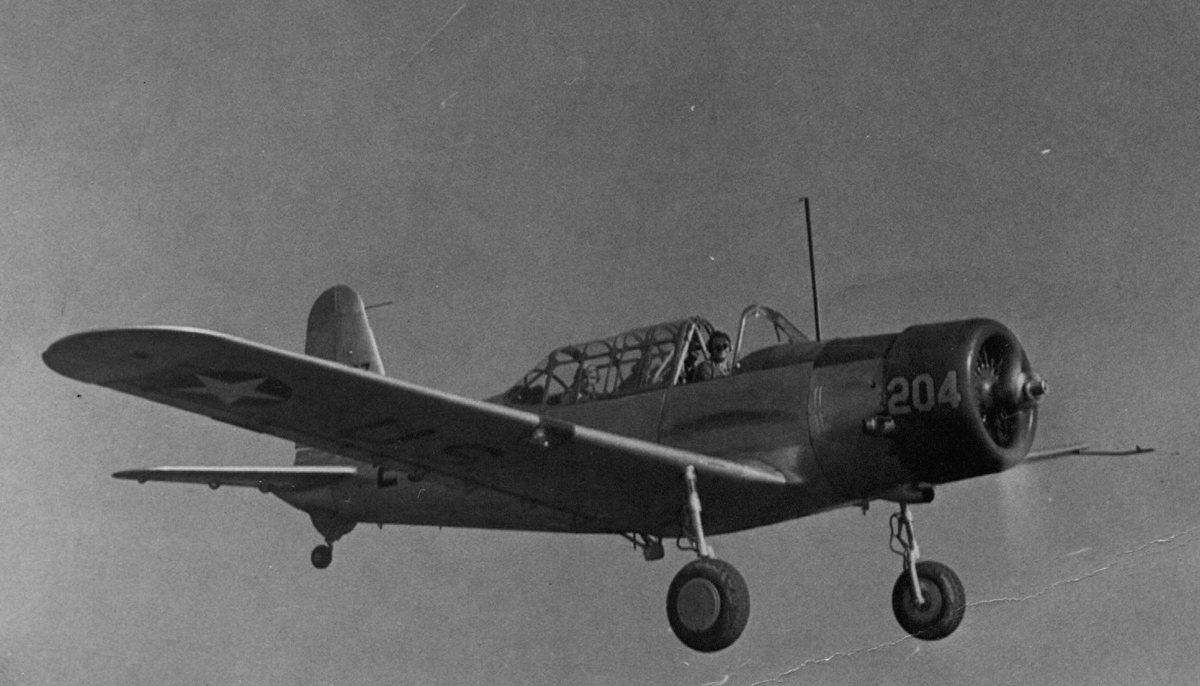
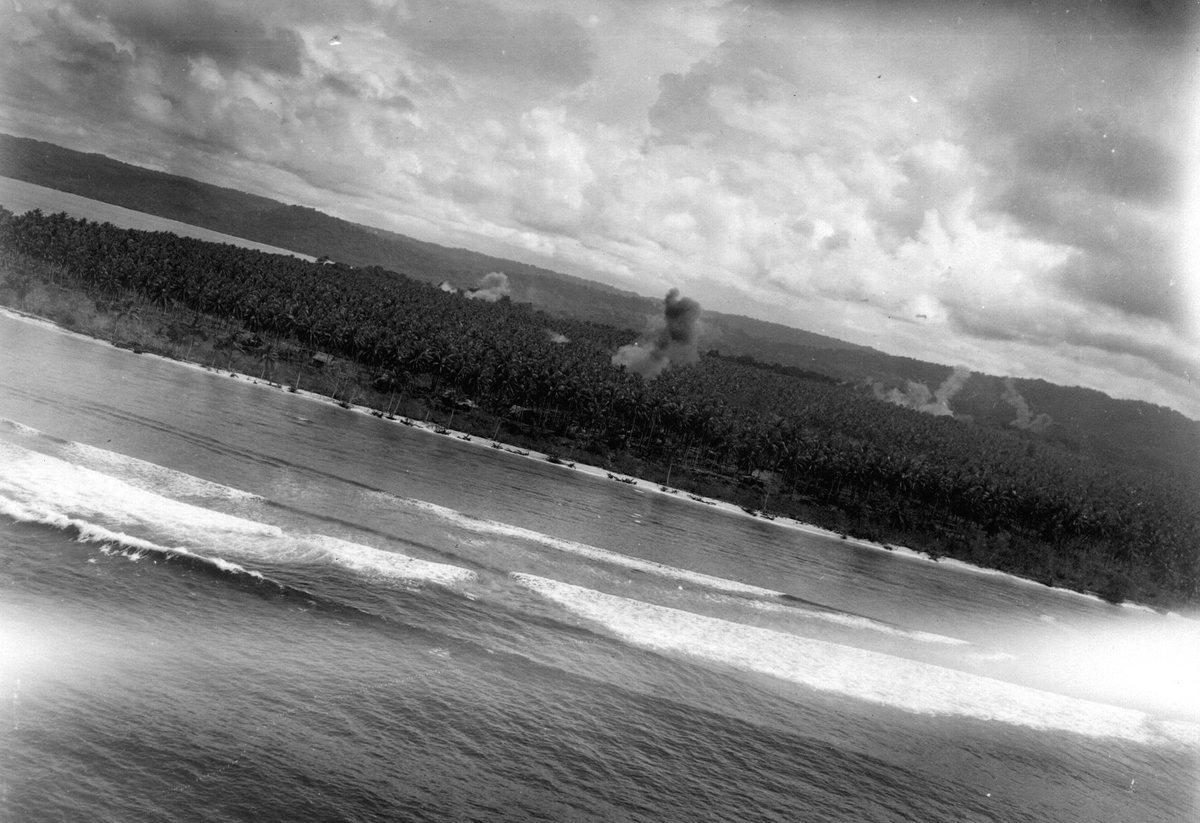
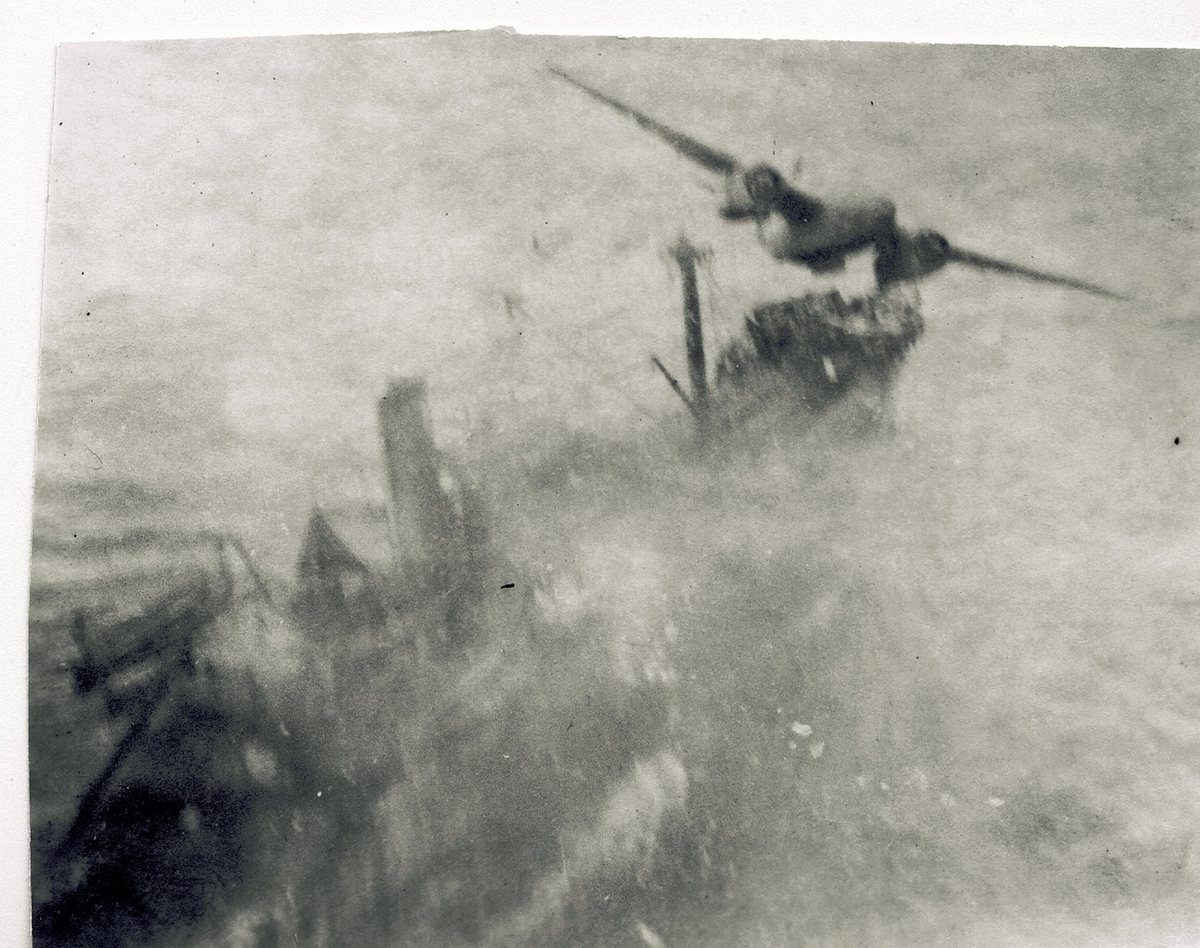
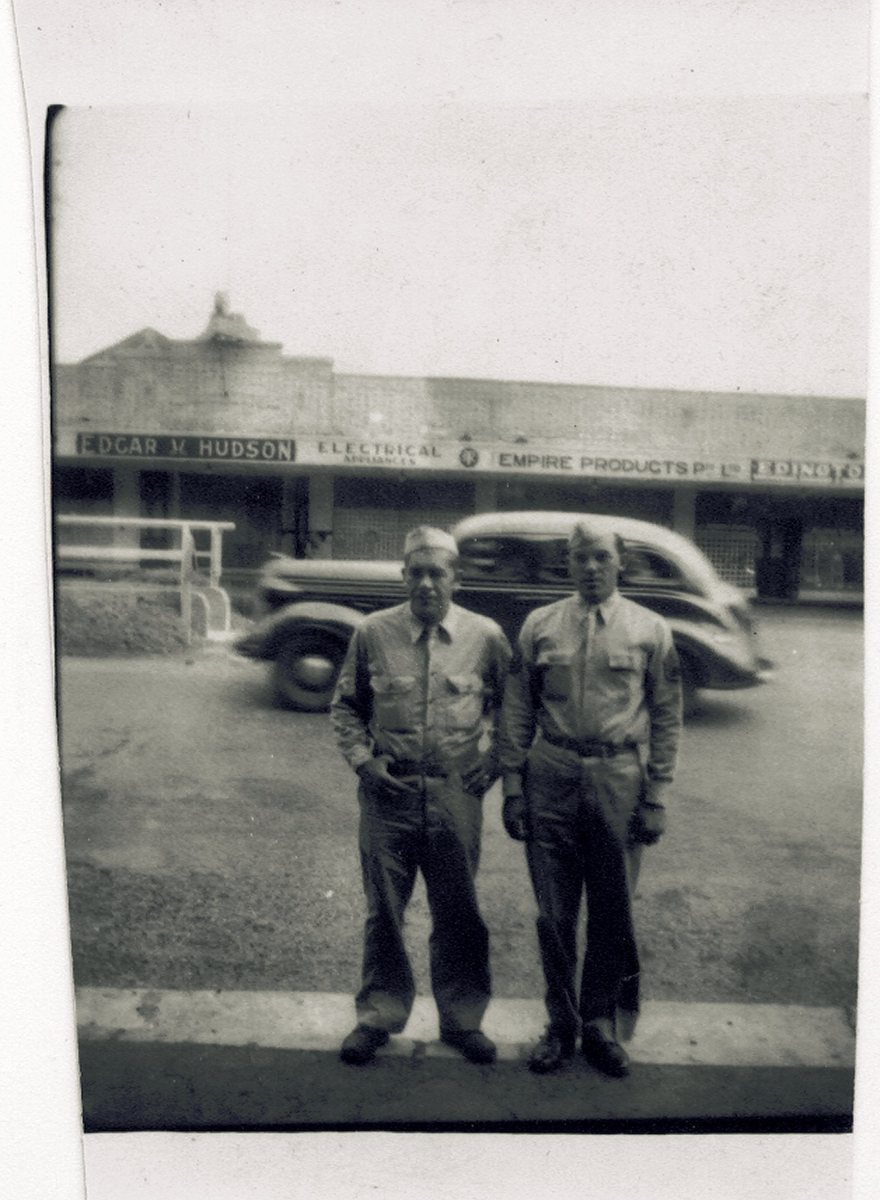
J
But how'd you, now, again, how'd you run into your cousin and the story, the story how it was mixed back home? Let's hear all that again.
A
I went over on the hangar that time and spent some time and find out what spot were we going to stay for the night and all that. And I noticed an ambulance there with the. Marking, so when I knew my cousin was in that outfit, I asked the guys, did they know him? They said, oh, yeah. I said, well, we'll go back, tell him to come up. His cousin is from time from home, wants to see him out here. And he came and we went out and went to the mess hall at night, had dinner together and then went to a movie together. Of course, the story calmed a little bit. Yeah. But one of the two other times I met somebody from one was when we went down in Brisbane, right after we landed there, a gang of us went in town to look around. And it's so far by truck. And then we the rest of the street. I see a guy at one of the crossings, just ready to step off the curb, go across the street. And I recognized him. And I grabbed him by the shoulder and pulled him back and said, where do you think you're going? He was surprised, too. And we often talked about it, you know, in our years about how we met over there. And then another kid younger than me, he was in this neighborhood from here in Persona, met him over there.
A
Christmas. Christmas in the jungle. Not very nice. Not very nice.
J
Like it was?
A
Back to the old story, that one, I guess. It was Christmas Eve. I'm sitting in my tent with another guy. We were writing letters and listening to the radio. And I just happened to glance up and I look over and tears are running down his cheeks. That's another way. I said, let's get off. Let's go to the movies. This is driving me nuts. Okay, so I'm ready to go down to the movies and I said, wait a minute, I'm going to get some chewing gum out of my bag here. So I reach in the bag to get the chewing gum, one curtain squirt, and after that I come out of the bag with a scorpion hanging on my fingers. And then I had to go down to the medics, kind of a shot, and then we went to the movies. Happy, Merry Christmas.
“I just happened to glance up and I look over and tears are running down his cheeks.”Allen E. Sweigert
J
How about it?
J
White Christmas?
A
Yeah, the middle of you on the shoes, yeah.
J
Oh, I mean, did you get to hear that while you were over there? White Christmas?
A
Oh, that's what they play, that white Christmas inside at night. That's still, I don't know, I haven't heard that yet today. Your thoughts go back.
J
How do you feel about coming out?
A
I don't know, they just put me in.
A
I don't remember which base we were at anymore because there were two shows posted. one was the Bob Hope show and one was, I don't know, it said some lady. Truba Girls, I don't know what it was but you drew which ones you wanted to go because you only let half the crew go to that one and half go to the other one so I was lucky enough to get to the Bob Hope. I was a double bonus, you get Bob Hope and girls. the guys thought
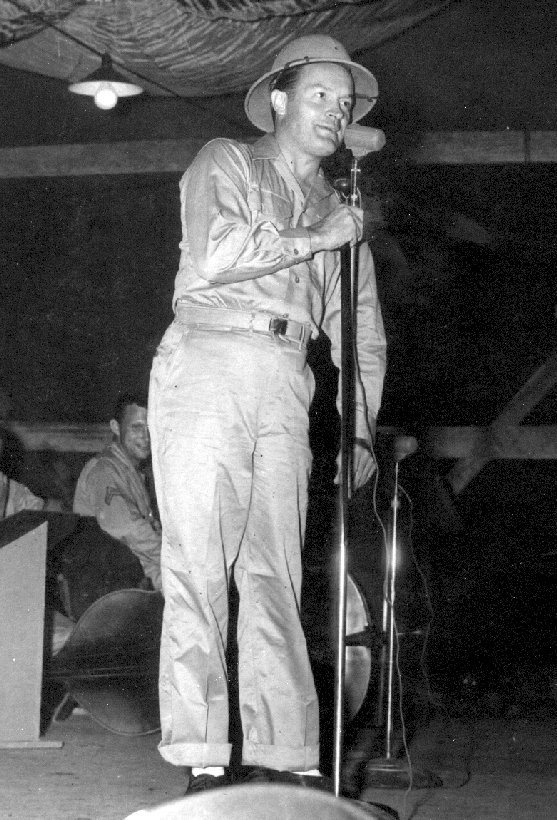
Source: OzAtWar (Peter Dunn, ozatwar.com), photo courtesy of Jack, a 90th Squadron veteran.
“I was a double bonus, you get Bob Hope and girls, the guys thought.”Allen E. Sweigert
J
when they come back
A
they were thoroughly disgusted they thought they were going to see some. some hot stuff with this group of girls and what it was was some some kind of a they put on. fully clothed. yeah, they were very much put on well, can you tell me all you can
J
from what you remember from the Bob Hope?
A
no, it was I know there was one. Blank, I think the name was I don't know, I can't remember the name but it was a great show and you'd be right some of the jokes you heard there it was a great show it was a little better than him on the radio yeah, when the guys were hooting and hollering the whole time it was really something
J
how many people got to go to like one show?
A
like when you, I mean oh, jeez, that must have. the side of the hill there thank God, there must have it was in the hundreds, I don't know because he was from all the squadrons all the groups around there it didn't matter whether they were sitting on the ground there you know what I mean
J
who cares what was where else are you going to get to see Bob Hope?
A
yeah. well, I'm in person
A
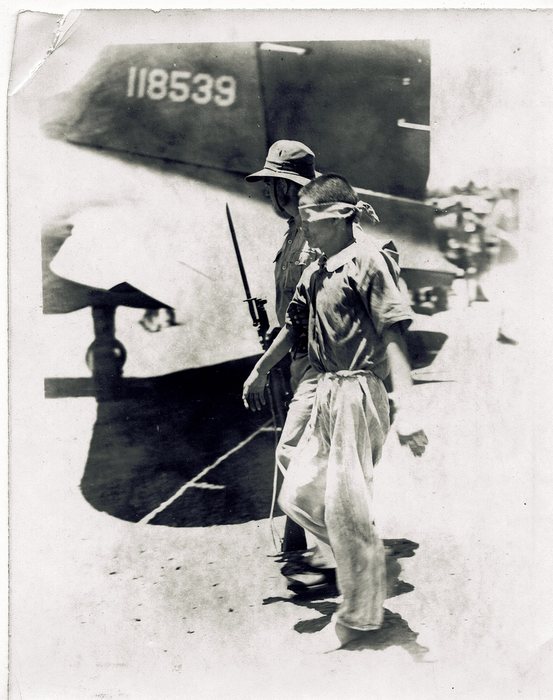
captured prisoners of war
J
do you have any contact with them?
A
the only contact I had with that
J
was when we landed at
A
Hollandia. they had just had the battle there the troops had gone the infantry had gone in I guess a day or two before and we came in with the LSTs and waded in there and then everybody was standing around the beach where do we go, you know and they marched a bunch of these prisoners by us there. that they had captured that's pretty much it there. you just want to show off the money and say just basically what that was or how you came about it where it came from
J
anytime you're ready
A
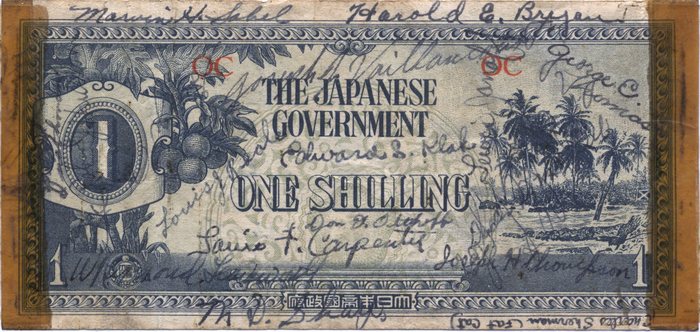
okay. so. here we have a couple of worthless little documents. Japanese. invasion money that they intended to use. when they got into Australia. half a shilling and a one pound note. absolutely worthless
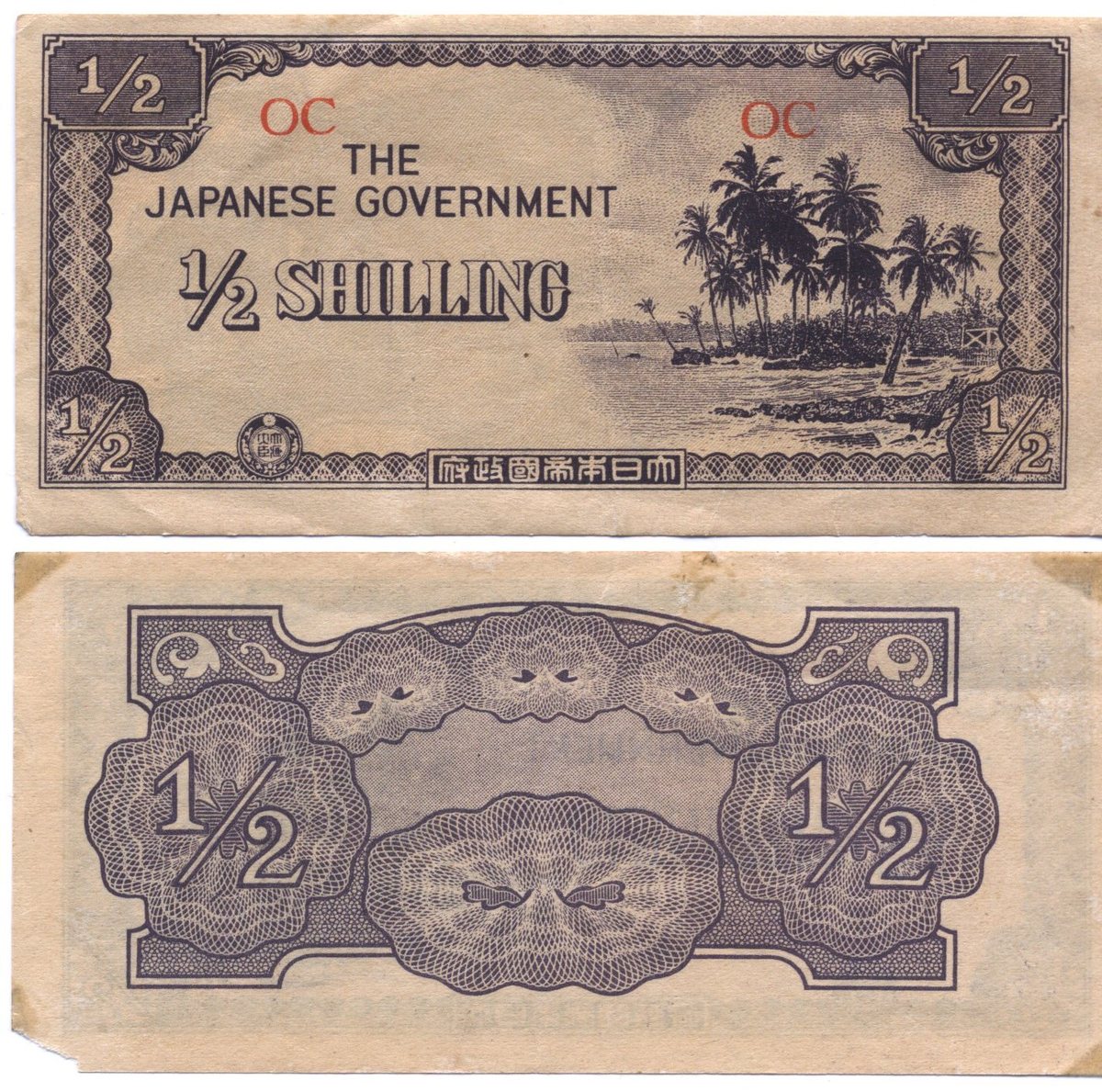
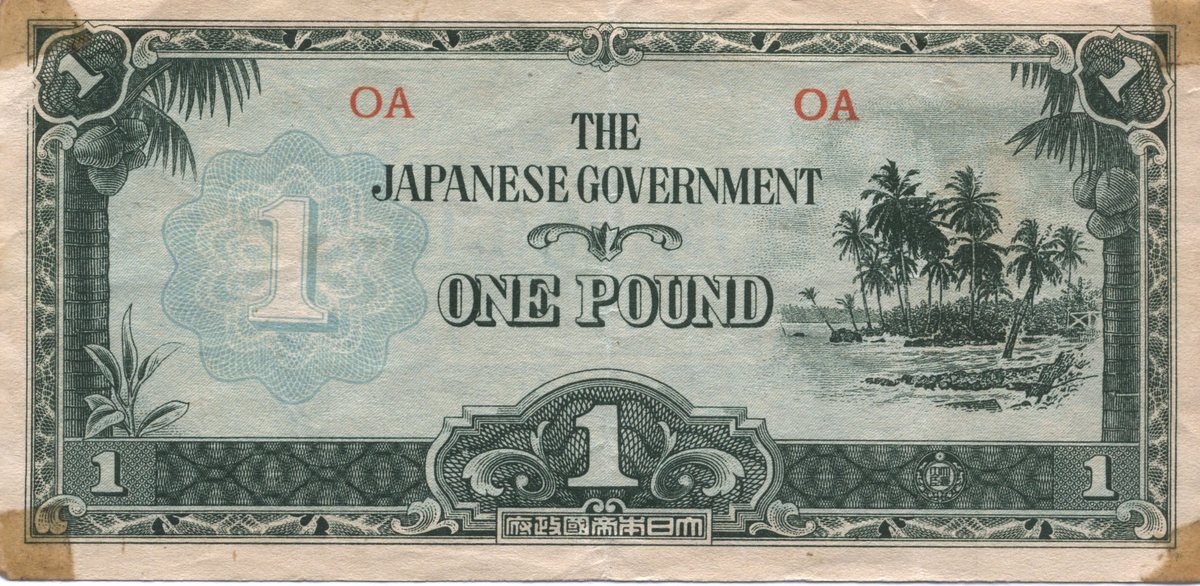
“Here we have a couple of worthless little documents — Japanese invasion money that they intended to use when they got into Australia. Half a shilling and a one pound note. Absolutely worthless.”Allen E. Sweigert
J
how did you get those? they just dropped them?
A
I don't know how I got a hold of them. I know there was zillions of them around but I don't know how I got a hold of them alright
J
tell me just exactly what
A
I can repeat it there about these suckers
J
this thing?
A
yeah these fake pieces of paper oh
J
what do you have there?
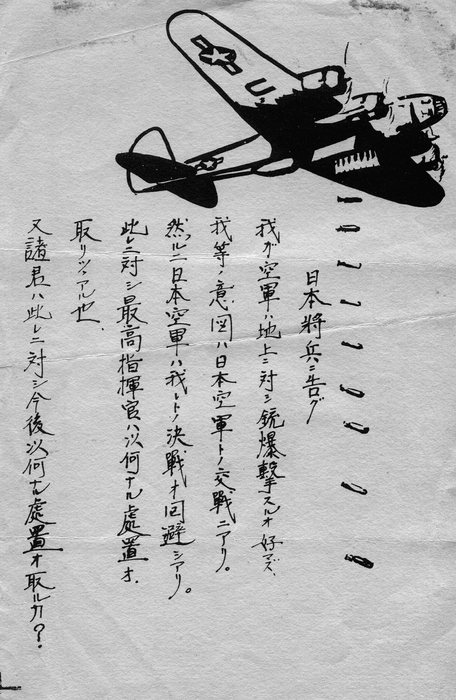
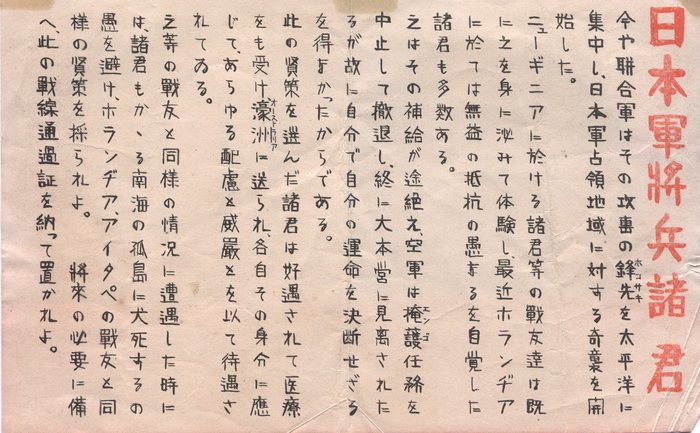
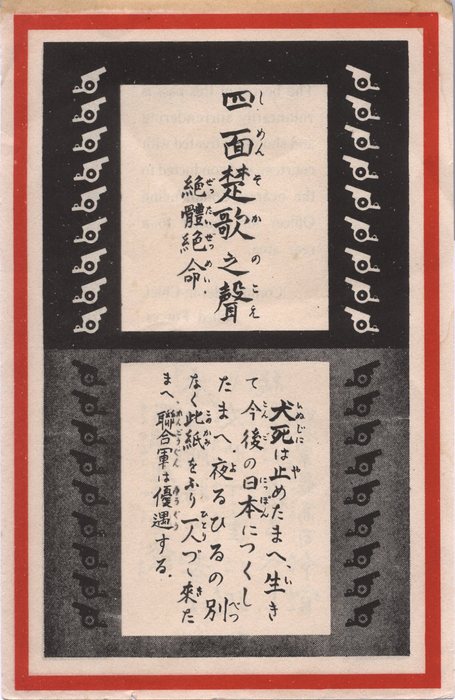
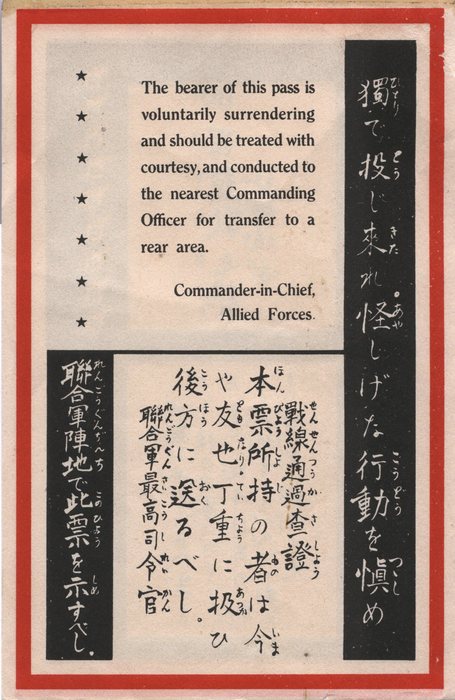
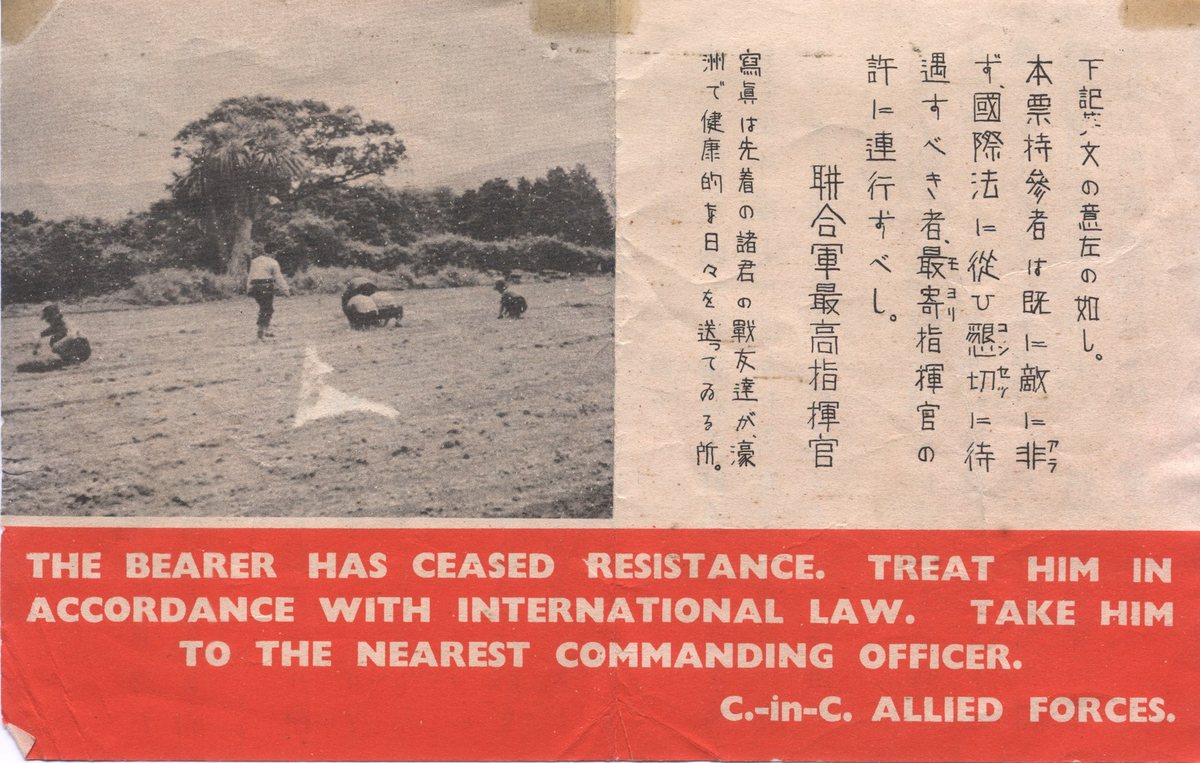
A
we have here a pass that that was dropped these were dropped to the Japanese. the bearer of this pass is voluntarily surrendering and should be treated with courtesy and conducted to the nearest commanding officer for transfer to a rear area. Well, that all depended on the mood of the captor, I might say, because with the annex or the stuff that they pulled in the Philippines, there was not too much love for the Japanese, and I guess it was more or less considered the only good Japanese was that didn't, because I don't know if that would have helped them any if they'd have waived this thing. Especially what they had just, maybe just done to one of the guy's buddies, maybe ours before, something like that.
J
Tell us a little bit about this group you're in. The who?
A
Oh, I mean the name of your group.
J
Oh, the group? Show us the front there.
A
All right, this is a book put out by our third bomb group of some of the actions in our time over there. In New Guinea and Australia.
A
What we had was a Mitchell B-25 medium bombers. When we first got there, it carried a crew of the two pilots, a bombardier, two gunners. And a video man. We soon learned that that was not necessary, because they took the bomb site out of there, and we were changed to a low-level strafing outfit. The lower turret was taken out. Machine guns were put into the front, into the nose, where the bomber usually was. And we had the machine guns. The machine guns out on the wings. We had just the one gunner and the two pilots as a crew. We no longer used the radio man, either.
“We soon learned that that was not necessary, because they took the bomb site out of there, and we were changed to a low-level strafing outfit.”Allen E. Sweigert
A
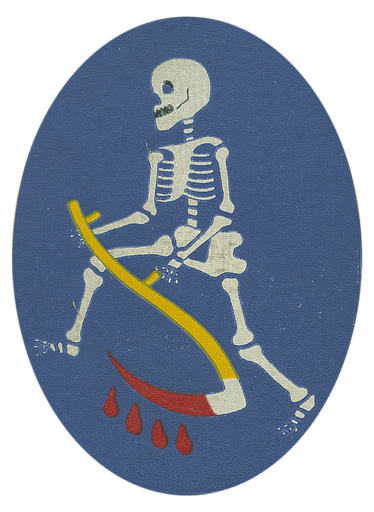
Four squadrons in the group. The 8th, the 13th, the 89th, and the bomb squadrons. Each one had their own insignias, and each one was still a different era than that is at Fort Mooresville. I'm not too sure where. I guess we're all pretty old again over here. You know how handy we were. And the other places we were was a place called Dogadura, which was on the east coast of New Guinea, below the bay. And then from there, we had moved up the Markham River Valley up into inland New Guinea. To a place called Nazab. That was one of the best places that we were at, because it was away from the jungle. And it was nice up there, really. It seemed like every afternoon the air currents would change, and it would come up the valley. And it was real pleasant in the evening there. In Nazab, we went again. We went again. We had another move, went down, got on boats up the coast of New Guinea, and then landed up at Hollandia. Hollandia, that was a big operation. We had to fight the bombers. It was quite busy. Years from there, that's where I left then to come back home. And came back on what had been a passenger ship. We had to get for the bats and lions before the war. It was going from California, where it was, to the Pacific. So that launched up the city of New Guinea. I never had a chance to go back. I wouldn't imagine so. And, well, we moved out yesterday.
J
Who's in the world?
A
You're gone.
J
You're not going to elaborate on that again?
A
Well, we knew that there was some kind of a scheduled location, the time spent in the service. And there were so many for each month, supposedly. And it took a long time to find out. But I found out then that I was supposed to be going the July quarter to go home. Well, it turned out. The May quarter was still there in September. So as far as being on the July quarter, I sort of missed there for a while. So things were going slow. And what happened is one night, it was on my birthday. So on the night, I was at a movie up in the hills. And when I come back to the camp, there was a lot of shouting going on and yelling. And I got on the telephone I had in my tent. And the guy says, you're going home tomorrow. And I thought, this is kind of a cool joke. Shouldn't be saying things like that. Circled around and found out, yeah, this is true. And it turned out that the next day, the July and August quarters were all going. And the pre-quarters had a bit of sunshine. And sure enough, the next day, we were in Truxton all that night. All that nice stuff.
A
And things would come in there. Turned out to help process the paperwork to get on. And I went on board the ship. And we take off. And I'm on the sergeant's guard. No more on the ship. I had to wait. I had to be there at a certain time. And they had to go. So they couldn't get up. People's process said, oh, well, I'll just do that. And so we come back across the Pacific all by ourselves in one ship. And the rest of us know nothing. I'll tell you, when we came inside on in California and approached into the bay, everything was quiet. We just stood there and just watched. We sailed under the San Francisco, the Golden Gate Bridge. And once we were under that, it seemed like everybody on board ship left a hoot. Because they figured, if it's now, we can go the rest of the way. And, well, we come into the pier. And it's quiet. It's quiet. We're not going on there.
“We sailed under the San Francisco, the Golden Gate Bridge. And once we were under that, it seemed like everybody on board ship let out a hoot.”Allen E. Sweigert
A
And March is through. The pier. And on the other side, we're right under another boat. Oh, my God, they're going to take us back over there again. And, you know, we went down the bay to an Army depot there, Angel Island, I think they called it. And then we were issued new uniforms, new this, new that. And then the next day, we headed for Fort Dix, New Jersey. Again, in Karen and I. And I called home and had my dad on the phone, told him I'd be home the next day.
“Oh, my God, they're going to take us back over there again.”Allen E. Sweigert
J
What did he say?
A
Okay. He was real happy. And, of course, the next day, he took us into Trenton, New Jersey, on a train there in Philadelphia, and then made connections to come up, up into home. And there were a lot of train and traffic people riding those days. And, of course, a guy in uniform getting on a train was, you know, I don't know what, everybody was real nice to you. And coming off the train and had these insignias on and the different stripes and medals and whatnot that you wore in your uniform. And I guess you were just a sort of a center of attraction. A celebrity, basically. I got a little excited then when I got to Coastal. I was close to getting off at the station. It was in Schuylkill Haven. I looked out the window and it was raining. So I'm trying to get my bag open to get my raincoat on. I'm all fingers and all thumbs and all what. I don't know. But all excited. Finally got it out, got it on. And when the train was that long that the coach I was in was, oh, maybe about 50 yards down from the station. And I got off the train and started carrying my bags up toward the station. And my mother and dad and two of my neighbors were there to meet me. And I heard one of them say, oh, here he comes now.
“Coming off the train and had these insignias on and the different stripes and medals and whatnot that you wore in your uniform. I guess you were just a sort of a center of attraction.”Allen E. Sweigert
A
That started the celebration. Well, you got home. I got home. And you got to see your wife-to-be for the first time. Yeah. The last time I was home was Friday. It was my favorite day of 41. You got home. I was only there for about a half a day. And now here it is, September or October the 7th of 44. And let me pause one more time. The celebration is beginning. You arrive home. I come in. And they were in the back porch. And they had the light turned on. And my girlfriend was running off. Take your time, Pat.
A
Well, that was a little celebration right there. Pretty much three years. I heard my dad say to our dog, who was never got any other name but Puppy. Puppy's out on the porch. She come running out, jumping all over. That's her doggy. All that time.
“I heard my dad say to our dog, who never got any other name but Puppy: ‘Puppy's out on the porch.’ She come running out, jumping all over.”Allen E. Sweigert
A
And she hung with me all that night until I went to bed that night. The dog was right there.
J
How old was Pup then? Hmm? How old was Pup then?
A
Oh, well, he had to be, he had to be about six, seven, eight years old, I guess. Wow. He was getting. That's pretty amazing. Because I had it quite a while before I went away. I know that.
A
Yep. It wasn't much. I don't even, I don't know if we had a little snack that night. I don't know. I don't remember. I really don't. It was probably the best sleep we've had in a long time. But I'll tell you that night, well, it was out on the seventh. And we decided right then and there we were getting married the next Saturday.
J
That same night?
A
Because when I, when I came up, I told my parents, I said, we're getting married next Saturday. A week right after the day you got home. We had, we had to, the next day, Sunday, I went, I went over, went to church. And a lot of people then, even, even one of the guys that was in the service, he had, he was home. He had, a tank was burned. He was burned up pretty good. Met him. We had, we had a big Sunday dinner. I don't know what we had. I don't know. But the story goes, they got out, they went to China and everything. Big celebration.
A
It's the last time that China was used. Yeah. Well, I don't know. I'm not used to war, but I know that.
“I'm not used to war, but I know that.”Allen E. Sweigert
Prisoners and Losses
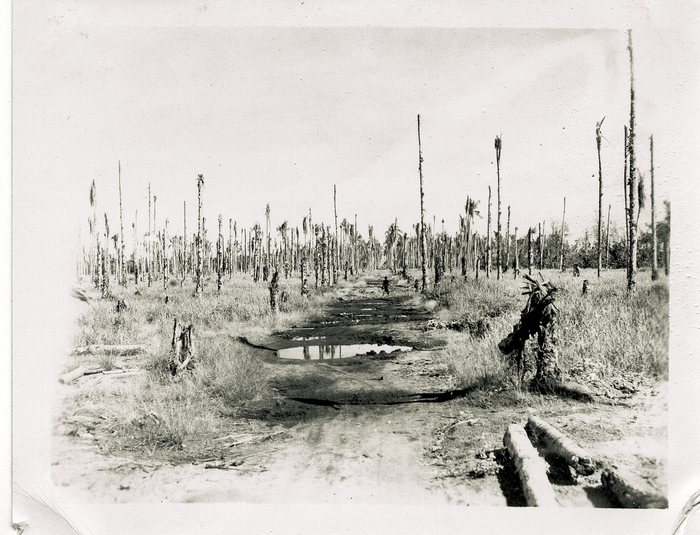
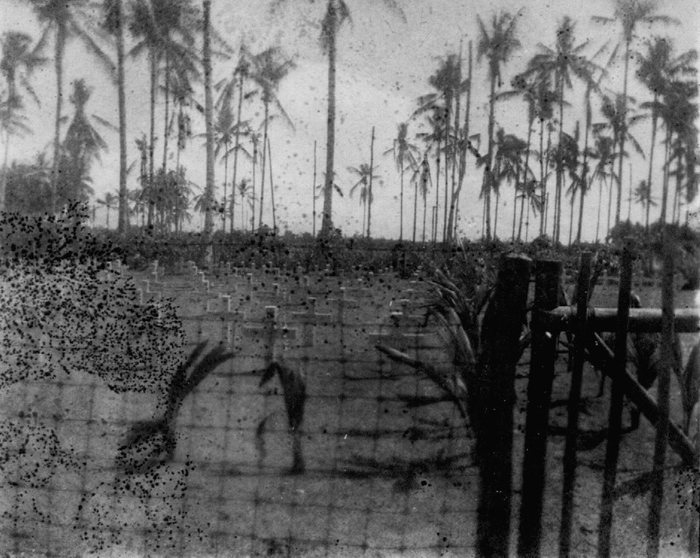
Two moments Allen's camera recorded near Hollandia, and the cost of the campaign.
Documents He Brought Home
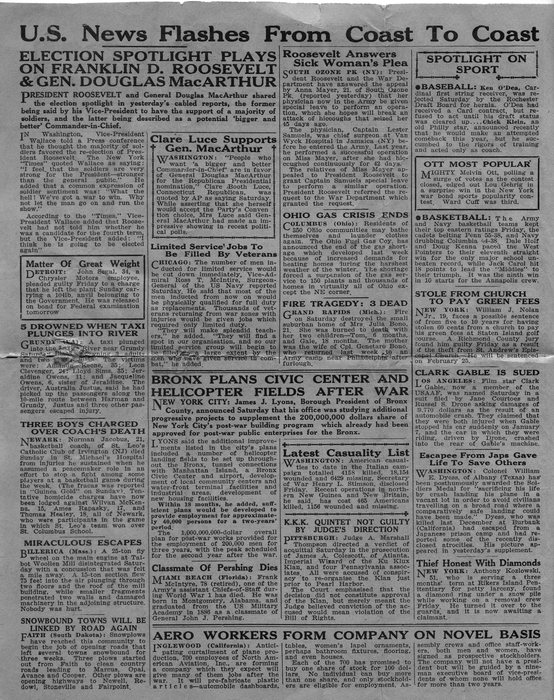
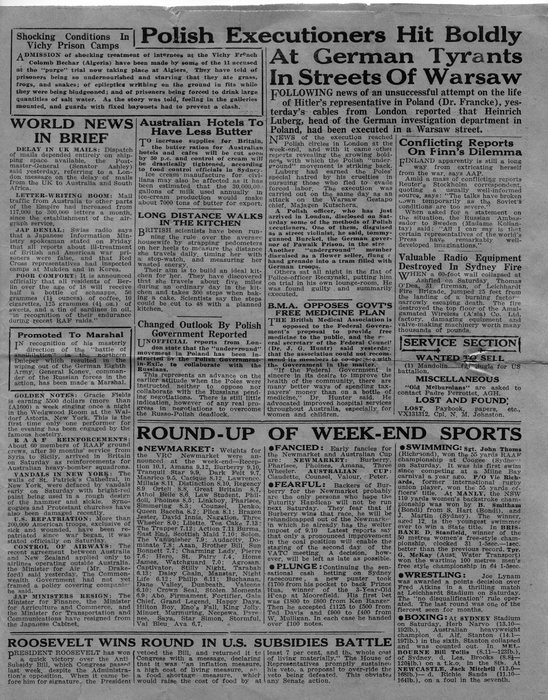
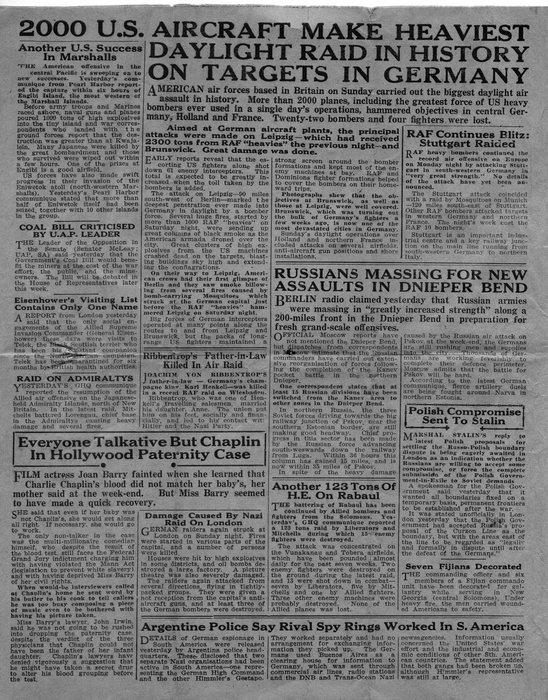
The New Guinea field newspaper, a signed occupation note, and Japanese-language leaflets Allen kept from his service.